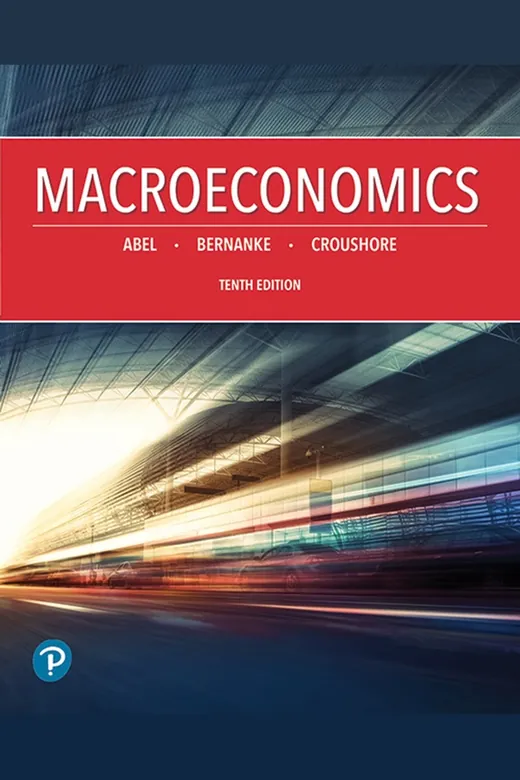
The cover of Macroeconomics

Macroeconomics

What determines a nation's long run growth, its swings in activity, its unemployment and its inflation?

At a glance

Author
Andrew B. Abel, Ben S. Bernanke, Dean Croushore

Why read it

  • You will understand why some economies grow fast and raise living standards while others stay stagnant
  • You will see why economies swing between prosperity and hard times, as in a financial crisis
  • You will learn why unemployment reaches very high levels and why some remains even in good times

Who it is for

  • A first year student starting macroeconomics
  • A professional following news on inflation, jobs and growth
  • A policy analyst who wants the core models

Contents

  1. Welcome
  2. Welcome
  3. 1: Introduction to Macroeconomics (Part 1: Introduction)
  4. Introduction: Introduction to Macroeconomics
  5. 1.1: What Macroeconomics Is About
  6. 1.2: What Macroeconomists Do
  7. 1.3: Why Macroeconomists Disagree
  8. Chapter Summary: Introduction to Macroeconomics
  9. 2: The Measurement and Structure of the National Economy
  10. Introduction: The Measurement and Structure of the National Economy
  11. 2.1: National Income Accounting: The Measurement of Production, Income, and Expenditure
  12. 2.2: Gross Domestic Product
  13. 2.3: Saving and Wealth
  14. 2.4: Real GDP, Price Indexes, and Inflation
  15. 2.5: Interest Rates
  16. Chapter Summary: The Measurement and Structure of the National Economy
  17. 3: Productivity, Output, and Employment (Part 2: Long-Run Economic Performance)
  18. Introduction: Productivity, Output, and Employment
  19. 3.1: How Much Does the Economy Produce? The Production Function
  20. 3.2: The Demand for Labor
  21. 3.3: The Supply of Labor
  22. 3.4: Labor Market Equilibrium
  23. 3.5: Unemployment
  24. 3.6: Relating Output and Unemployment: Okun’s Law
  25. Chapter Summary: Productivity, Output, and Employment
  26. Appendix 3.A: The Growth Rate Form of Okun’s Law
  27. 4: Consumption, Saving, and Investment
  28. Introduction: Consumption, Saving, and Investment
  29. 4.1: Consumption and Saving
  30. 4.2: Investment
  31. 4.3: Goods Market Equilibrium
  32. Chapter Summary: Consumption, Saving, and Investment
  33. Appendix 4.A: A Formal Model of Consumption and Saving
  34. 5: Saving and Investment in the Open Economy
  35. Introduction: Saving and Investment in the Open Economy
  36. 5.1: Balance of Payments Accounting
  37. 5.2: Goods Market Equilibrium in an Open Economy
  38. 5.3: Saving and Investment in a Small Open Economy
  39. 5.4: Saving and Investment in Large Open Economies
  40. 5.5: Fiscal Policy and the Current Account
  41. Chapter Summary: Saving and Investment in the Open Economy
  42. 6: Long-Run Economic Growth
  43. Introduction: Long-Run Economic Growth
  44. 6.1: The Sources of Economic Growth
  45. 6.2: Long-Run Growth: The Solow Model
  46. 6.3: Endogenous Growth Theory
  47. 6.4: Government Policies to Raise Long-Run Living Standards
  48. Chapter Summary: Long-Run Economic Growth
  49. 7: The Asset Market, Money, and Prices
  50. Introduction: The Asset Market, Money, and Prices
  51. 7.1: What Is Money?
  52. 7.2: Portfolio Allocation and the Demand for Assets
  53. 7.3: The Demand for Money
  54. 7.4: Asset Market Equilibrium
  55. 7.5: Money Growth and Inflation
  56. Chapter Summary: The Asset Market, Money, and Prices
  57. 8: Business Cycles (Part 3: Business Cycles and Macroeconomic Policy)
  58. Introduction: Business Cycles
  59. 8.1: What Is a Business Cycle?
  60. 8.2: The American Business Cycle: The Historical Record

More books like this