Knowingo
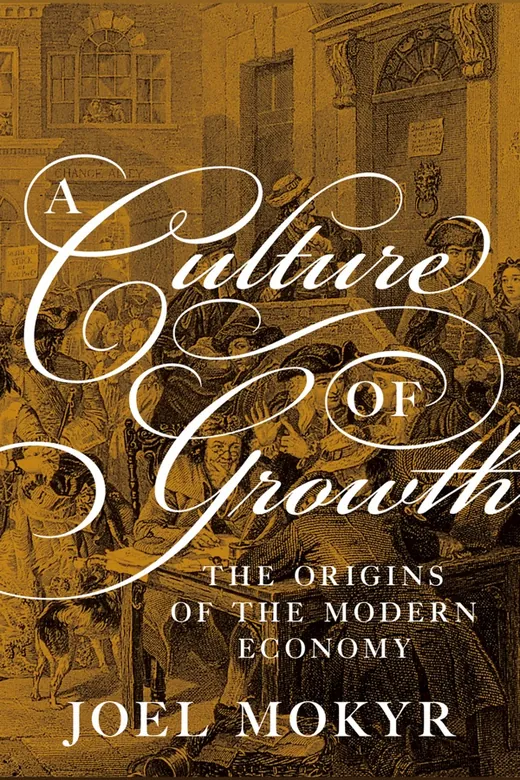
The cover of A Culture of Growth: The Origins of the Modern Economy

A Culture of Growth: The Origins of the Modern Economy

Why did European invention become sustained growth? Joel Mokyr traces how beliefs about useful knowledge, open inquiry, and exchange between scholars and makers helped technology keep advancing.

9 parts, about 29 minutes to read.

At a glance

Author
Joel Mokyr
Parts
9 parts
Reading time
about 29 minutes
The whole book
Also to read in full

The idea people argue about

Mokyr's most contested claim is that a change in beliefs about useful knowledge helped make modern economic growth possible in Europe. A common objection is that this gives ideas too much causal weight compared with coal, colonies, wages, state capacity, institutions, and access to trade. Mokyr answers that culture is not a national personality or an isolated first cause: it works through incentives, institutions, communication, and communities that reward inquiry and application. His Republic of Letters matters because it made claims contestable across borders and connected learned knowledge with practical improvement. He also compares Europe with China to explain why knowledge systems developed differently without claiming that Europeans possessed greater innate ability. The dispute remains one of causal balance, since the book shows how intellectual norms can amplify material opportunities more readily than it can assign a precise share of industrial growth to culture alone.


Three common misunderstandings

  1. Culture in the book does not mean a fixed national character shared by every European across several centuries. Mokyr describes changing beliefs, institutions, networks, and incentives that varied across places and could be learned, openly contested, and transmitted.
  2. The argument does not say that scientific theory simply produced each early industrial invention through direct application. It emphasizes feedback between skilled practice and formal knowledge, with artisans, engineers, experimenters, and scholars contributing different kinds of useful knowledge over long periods.
  3. The comparison with China does not claim that China lacked invention, technical skill, sophisticated learning, or major economic achievements. Mokyr examines why different institutions and intellectual incentives affected the long term accumulation and public contest of useful knowledge.

What the summary covers

  1. How a culture helped make growth durable4 min
  2. Bacon and Newton as intellectual examples3 min
  3. People, learning, and the supply of useful knowledge4 min
  4. Rival states and a shared scholarly world4 min
  5. Progress becomes a practical expectation4 min
  6. What useful knowledge did in the first Industrial Revolution3 min
  7. China and the distinctiveness of the European path3 min
  8. Chinese movements of inquiry and the book’s conclusion3 min
  9. A contingent achievement1 min

Read it alongside

More books like this