Knowingo
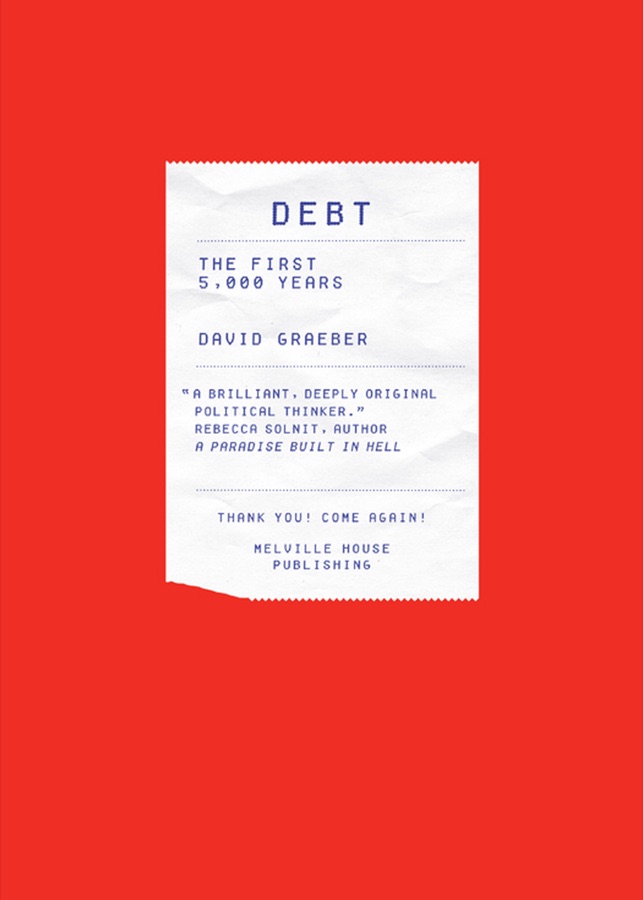
The cover of Debt: The First 5,000 Years

Debt: The First 5,000 Years

Graeber traces five thousand years of debt through coinage, slavery and empire, and shows why the demand that debts be paid is a moral claim, not an economic one.

12 parts, about 39 minutes to read.

Why read it

  • Challenges the textbook story that barter came first, arguing from ancient records that credit came before coins
  • Separates three moral principles, communism, exchange and hierarchy, and defines debt as an exchange that has not been brought to completion
  • Divides Eurasian history into alternating ages of virtual credit and bullion coin, tying each swing to war and slavery

Who it is for

  • Readers who want to know where money and credit came from
  • Readers questioning whether every debt must be repaid
  • History readers drawn to how war and slavery shaped markets

What the summary covers

  1. The Question Nobody Asks4 min
  2. The Myth of Barter3 min
  3. Where Money Really Came From3 min
  4. Debt, Sin, and Redemption2 min
  5. Three Moral Principles4 min
  6. Human Economies and the Price of a Life4 min
  7. Honor and Degradation4 min
  8. Credit, Bullion, and the Cycles of History2 min
  9. The Axial Age4 min
  10. The Middle Ages3 min
  11. The Age of the Great Capitalist Empires3 min
  12. 1971 and After3 min

Recommended by

  • Cory DoctorowBoingBoing writer
    An absolutely indispensable—and enormous—treatise on the history of money and its relationship to inequality in society.

About the author

  • David GraeberAnthropologist and activist who died in 2020
    • Master's degree and doctorate from the University of Chicago; 20 months of fieldwork in rural Madagascar from 1989 on a Fulbright
    • Assistant professor at Yale from 1998
    • Yale did not renew his contract in 2005
    • Professor at the London School of Economics from 2013
    • Credited by Rolling Stone with the Occupy Wall Street theme 'We are the 99 percent' (November 2011)
    • Died suddenly in Venice on 2 September 2020

More books like this