Knowingo
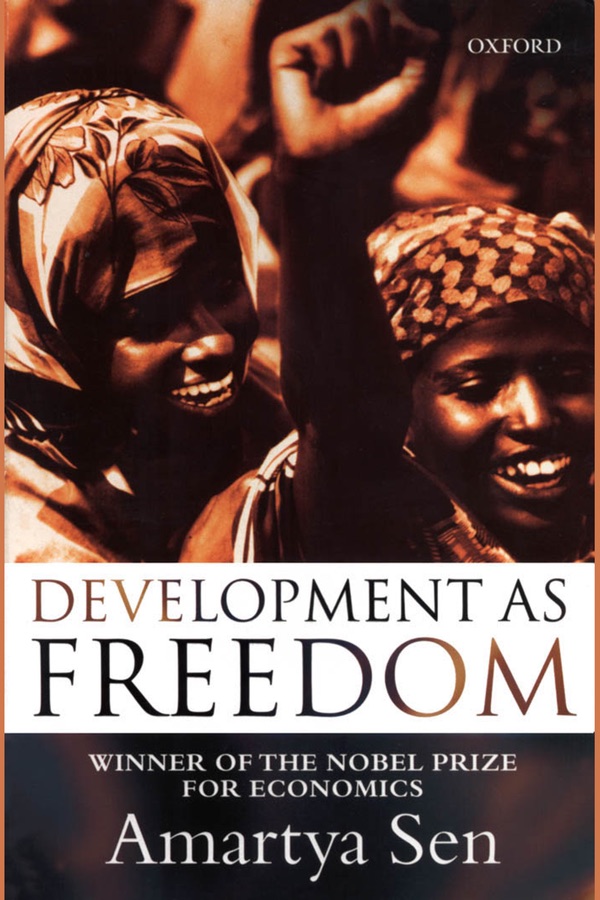
The cover of Development as Freedom

Development as Freedom

Why development should be judged by the real freedoms people gain, shown through famines, missing women, and the records of India, China and Kerala.

14 parts, about 31 minutes to read.

Why read it

  • Redefines development as expanding real freedoms rather than raising national income, and lists five freedoms that reinforce one another
  • Defines poverty as lack of basic capabilities, showing how income misses disability, gender and illness, with the case of missing women
  • Argues that democracy and a free press prevent famine, and answers the claim that Asian values or growth justify authoritarian rule

Who it is for

  • Readers asking why national income misses how people actually live
  • Students of development, poverty and public policy
  • Citizens weighing democracy against economic growth

What the summary covers

  1. Preface1 min
  2. Introduction: Development as Freedom2 min
  3. The Perspective of Freedom3 min
  4. The Ends and the Means of Development3 min
  5. Freedom and the Foundations of Justice2 min
  6. Poverty as Capability Deprivation3 min
  7. Markets, State and Social Opportunity2 min
  8. The Importance of Democracy3 min
  9. Famines and Other Crises3 min
  10. Women's Agency and Social Change2 min
  11. Population, Food and Freedom2 min
  12. Culture and Human Rights2 min
  13. Social Choice and Individual Behavior1 min
  14. Individual Freedom as a Social Commitment2 min

Recommended by

  • Kenneth J. ArrowNobel Laureate in Economic Science
    In this book, Amartya Sen develops elegantly, compactly, and yet broadly the concept that economic development is in its nature an increase in freedom.
  • Kofi A. AnnanSecretary General of the United Nations
    The world's poor and dispossed could have no more articulate or insightful a champion among economists than Amartya Sen.
About the author

  • Amartya SenIndian economist and philosopher, Nobel laureate and Harvard University professor
    • Born in Santiniketan, on the campus of Rabindranath Tagore's Visva Bharati school and college
    • Watched the Bengal famine of 1943, in which two to three million people died, from Santiniketan; the memory was still fresh in his student years at Presidency College
    • Moved from Calcutta to Cambridge in 1953 to study at Trinity College
    • Appointed to a chair in economics at the newly created Jadavpur University in Calcutta, where he set up a new economics department before turning 23
    • Spent a four year Prize Fellowship at Trinity studying philosophy
    • Wrote Poverty and Famines (1981), written for the International Labour Organization's World Employment Programme
    • Worked with Mahbub ul Haq from 1989 on the United Nations Development Programme's Human Development Reports, a broader way of assessing development
    • Became Master of Trinity College, Cambridge, from January 1998

More books like this