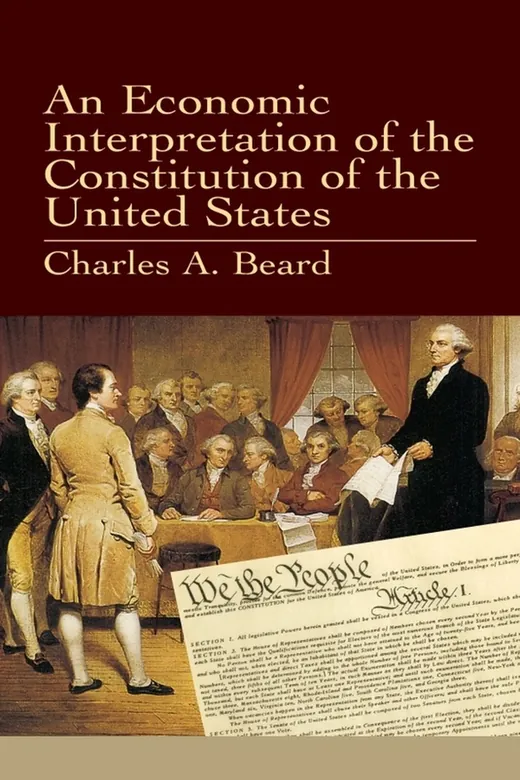
The cover of An Economic Interpretation of the Constitution of the United States

An Economic Interpretation of the Constitution of the United States

Did the men who wrote the American Constitution act from principle alone, or from their own property and money interests?

At a glance

Author
Charles A. Beard

Why read it

  • You will learn to ask who gains financially when a law or system is created
  • You will weigh the argument that property rights were placed beyond the reach of voting majorities
  • You will notice who was left out of the room, since a large propertyless mass could not take part

Who it is for

  • Civics students questioning the founding story
  • Readers who check who profits before trusting a reform
  • Teachers wanting a pointed argument for class debate

Contents

  1. PREFACE
  2. CHAPTER I
  3. HISTORICAL INTERPRETATION IN THE UNITED STATES
  4. CHAPTER II
  5. A SURVEY OF ECONOMIC INTERESTS IN 1787
  6. THE DISFRANCHISED
  7. GROUPS OF REAL PROPERTY HOLDERS
  8. GROUPS OF PERSONAL PROPERTY INTERESTS
  9. CHAPTER III
  10. THE MOVEMENT FOR THE CONSTITUTION
  11. CHAPTER IV
  12. PROPERTY SAFEGUARDS IN THE ELECTION OF DELEGATES
  13. CHAPTER V
  14. THE ECONOMIC INTERESTS OF THE MEMBERS OF THE CONVENTION
  15. CHAPTER VI
  16. THE CONSTITUTION AS AN ECONOMIC DOCUMENT
  17. THE UNDERLYING POLITICAL SCIENCE OF THE CONSTITUTIONS ³⁸⁷
  18. 1. THE STRUCTURE OF GOVERNMENT OR THE BALANCE OF POWERS
  19. II. THE POWERS CONFERRED UPON THE FEDERAL GOVERNMENT
  20. III. RESTRICTIONS LAID UPON STATE LEGISLATURES
  21. THE ECONOMICS OF INTERNATIONAL POLITICS
  22. CHAPTER VII
  23. THE POLITICAL DOCTRINES OF THE MEMBERS OF THE CONVENTION
  24. CHAPTER VIII
  25. THE PROCESS OF RATIFICATION
  26. CHAPTER IX
  27. THE POPULAR VOTE ON THE CONSTITUTION
  28. CHAPTER X
  29. THE ECONOMICS OF THE VOTE ON THE CONSTITUTION
  30. MEMBERS WHO VOTED IN FAVOR OF RATIFICATION
  31. OPPONENTS OF RATIFICATION
  32. CHAPTER XI
  33. THE ECONOMIC CONFLICT OVER RATIFICATION AS VIEWED BY CONTEMPORARIES
  34. MARSHALL’S ANALYSIS OF THE CONFLICT
  35. THE CONFLICT IN THE STATES
  36. CONCLUSIONS

More books like this