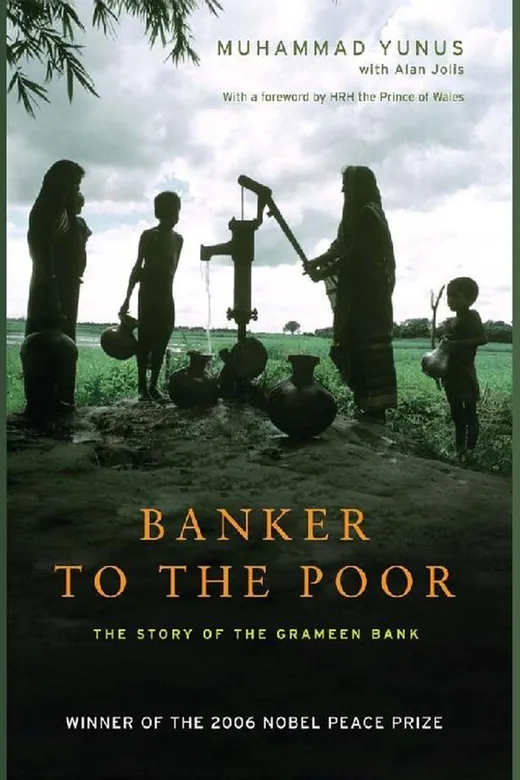
The cover of Banker to the Poor: The Story of the Grameen Bank

Banker to the Poor: The Story of the Grameen Bank

Can small loans to poor people with no collateral help them take control of their own lives?

At a glance

Author
Muhammad Yunus

Why read it

  • You will see how a bank can be designed for people with no land or assets
  • You will understand why listening to the people you want to help beats a grand plan from above
  • You will learn how one small experiment can grow into a national institution

Who it is for

  • Social entrepreneurs designing a service for people left out
  • Development workers weighing aid against lending
  • Bankers asking whom a new model could serve

Contents

  1. Foreword by H.R.H. The Prince of Wales
  2. Author’s Preface
  3. PART I: BEGINNINGS 1940–76
  4. 1 Jobra Village: from Textbook to Reality
  5. 2 The World Bank, Washington, DC, November 1993
  6. 3 20 Boxirhat Road, Chittagong
  7. 4 Through the Viewfinder: Boyhood Passions
  8. 5 Campus Years in the US, 1965–72
  9. 6 Marriage and the War of Liberation, 1967–71
  10. 7 Chittagong University, 1972–74
  11. 8 Farming: the Three-Share Farm Experiment, 1974–76
  12. 9 Banking: Climbing the Prison Walls of Collateral, 1976
  13. 10 Why Lend to Women rather than to Men?
  14. 11 Reaching Women Borrowers
  15. 12 Women Bank Workers
  16. 13 The Delivery System: the Mechanics of Joining
  17. 14 The Repayment Mechanism: the World Upside Down
  18. 15 A Comparison with Conventional Banks
  19. 16 Grameen as an Experimental Branch of the Agricultural Bank, 1977–79
  20. 17 Eid-Ul Fitr, 1977
  21. 18 Taking our Time at the Start, 1979–83
  22. 19 Against the Mind-Set
  23. 20 Natural Disasters: Our Other Enemies
  24. 21 Training Grameen Staff
  25. 22 Birth of Grameen as a Separate Corporate Entity, 1982–83
  26. 23 Full Independence of the Bank, 1985–90
  27. 24 International Replications
  28. 25 The US Urban Experience
  29. 26 The US Rural Experience
  30. 27 Discovering Economics: the Social Consciousness-Driven Free Market
  31. 28 Self-Employment
  32. 29 What Role for Educating and Training the Poor?
  33. 30 On the Population Problem
  34. 31 Poverty: the Missing Issue in Economics
  35. Introduction
  36. 32 The Housing Loans: a Great Success Story
  37. 33 Health and Retirement
  38. 34 Grameen Check: Weavers are Back in Fashion
  39. 35 Grameen Fisheries Foundation
  40. 36 GrameenPhone: Technology for the Poor
  41. 37 The Grameen Trust: the People’s Fund
  42. 38 A World That Will Assist the Poorest
  43. 39 World Micro-Credit Summit: to Reach 100 million by the Year 2005
  44. 40 A Poverty-Free World: How and When?
  45. 41 What Would it be Like?
  46. Appendix I: A Look at the Balance Sheet
  47. Appendix II: Analysis of Some of the Most Popular Grameen Loans
  48. How to contact the Grameen Bank

More books like this