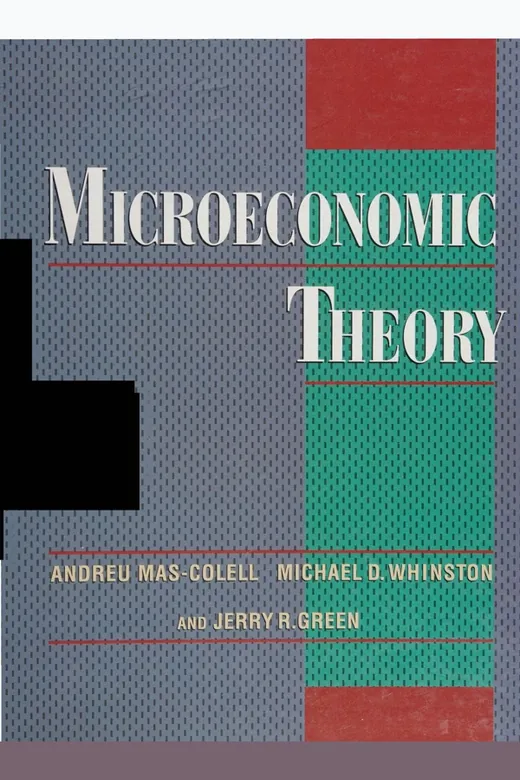
The cover of Microeconomic Theory

Microeconomic Theory

How does microeconomic theory model economic life as individual agents pursuing their private interests, starting from a single decision maker?

At a glance

Author
Andreu Mas Colell, Michael D. Whinston, Jerry R. Green

Why read it

  • You will learn the two ways economists model a choice: from preferences that obey rules of rationality, or from consistent choice behavior
  • You will understand how economists model choice under uncertainty, strategic play and contracts where one side knows more
  • You will be able to test what the Walrasian equilibrium model can actually predict, rather than only what it says should happen

Who it is for

  • A graduate economics student starting a first course
  • A researcher who needs rigorous foundations for modeling choice
  • A policy analyst who wants the theory behind market reasoning

Contents

  1. PART ONE: INDIVIDUAL DECISION MAKING
  2. Chapter 1 Preference and Choice
  3. 1.A Introduction
  4. 1.B Preference Relations
  5. 1.C Choice Rules
  6. 1.D The Relationship between Preference Relations and Choice Rules
  7. Exercises
  8. Chapter 2 Consumer Choice
  9. 2.A Introduction
  10. 2.B Commodities
  11. 2.C The Consumption Set
  12. 2.D Competitive Budgets
  13. 2.E Demand Functions and Comparative Statics
  14. 2.F The Weak Axiom of Revealed Preference and the Law of Demand
  15. Exercises
  16. Chapter 3 Classical Demand Theory
  17. 3.A Introduction
  18. 3.B Preference Relations: Basic Properties
  19. 3.C Preference and Utility
  20. 3.D The Utility Maximization Problem
  21. 3.E The Expenditure Minimization Problem
  22. 3.F Duality: A Mathematical Introduction
  23. 3.G Relationships between Demand, Indirect Utility, and Expenditure Functions
  24. 3.H Integrability
  25. 3.I Welfare Evaluation of Economic Changes
  26. 3.J The Strong Axiom of Revealed Preference
  27. Appendix A: Continuity and Differentiability Properties of Walrasian Demand
  28. Exercises
  29. Chapter 4 Aggregate Demand
  30. 4.A Introduction
  31. 4.B Aggregate Demand and Aggregate Wealth
  32. 4.C Aggregate Demand and the Weak Axiom
  33. 4.D Aggregate Demand and the Existence of a Representative Consumer
  34. Appendix A: Regularizing Effects of Aggregation
  35. Exercises
  36. Chapter 5 Production
  37. 5.A Introduction
  38. 5.B Production Sets
  39. 5.C Profit Maximization and Cost Minimization
  40. 5.D The Geometry of Cost and Supply in the Single-Output Case
  41. 5.E Aggregation
  42. 5.F Efficient Production
  43. 5.G Remarks on the Objectives of the Firm
  44. Appendix A:The Linear Activity Model
  45. Exercises
  46. Chapter 6 Choice Under Uncertainty
  47. 6.A Introduction
  48. 6.B Expected Utility Theory
  49. 6.C Money Lotteries and Risk Aversion
  50. 6.D Comparison of Payoff Distributions in Terms of Return and Risk
  51. 6.E State-dependent Utility
  52. 6.F Subjective Probability Theory
  53. Exercises
  54. PART TWO: GAME THEORY
  55. Chapter 7 Basic Elements of Noncooperative Games
  56. 7.A Introduction
  57. 7.B What Is a Game?
  58. 7.C The Extensive Form Representation of a Game
  59. 7.D Strategies and the Normal Form Representation of a Game
  60. 7.E Randomized Choices

More books like this