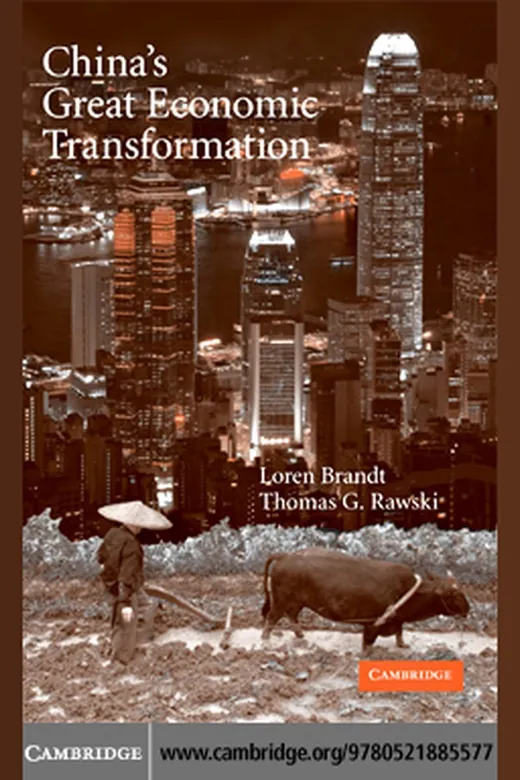
The cover of China's Great Economic Transformation

China's Great Economic Transformation

How did China grow so fast after reform began, how does its path compare with the former Soviet bloc, and can the growth last?

At a glance

Author
Loren Brandt, Thomas G. Rawski

Why read it

  • You will see how China's gradual reforms compare with the rapid reforms in Eastern Europe and the former Soviet Union
  • You will learn how economists forecast growth from labor, capital, education and productivity
  • You will understand how labor markets, population change and schooling feed into a country's growth

Who it is for

  • An economics student comparing development paths
  • A business leader with plans in China
  • A policy reader who wants evidence behind the growth story

Contents

  1. Half-title
  2. Title
  3. Figures
  4. Tables
  5. Contributors
  6. ONE China’s Great Economic Transformation
  7. BACKGROUND: CHINA’S ECONOMY PRIOR TO THE START OF ECONOMIC REFORM
  8. KEY FACTORS IN CHINA’S REFORM SUCCESS
  9. KEY ELEMENTS IN THE POLITICAL ECONOMY OF CHINESE REFORM
  10. CONCLUSION
  11. TWO China and Development Economics
  12. CHINA’S COMPARATIVE ECONOMIC PERFORMANCE: A QUANTITATIVE LOOK
  13. COMPARATIVE ECONOMIC PERFORMANCE: GOVERNANCE ISSUES
  14. AGRICULTURE AND LAND TENURE
  15. RURAL INDUSTRIALIZATION
  16. CONCLUSIONS
  17. THREE China in Light of the Performance of the Transition Economies
  18. INTRODUCTION
  19. STRATEGIES FOR TRANSITION
  20. PERFORMANCE OF CHINA AND THE CEE AND CIS ECONOMIES
  21. CONCLUSION
  22. FOUR A Political Economy of China’s Economic Transition
  23. ECONOMIC TRANSITION IN AN AUTHORITARIAN REGIME
  24. THE FIRST PERIOD OF TRANSITION, 1978 THROUGH 1993
  25. CONCLUSION: THE POLITICAL ECONOMY OF TWENTY-FIRST CENTURY CHINA
  26. FIVE The Demographic Factor in China’s Transition
  27. TWO AND A HALF DECADES OF DEMOGRAPHIC CHANGE
  28. IS CHINA’S FERTILITY DECLINE YIELDING DIVIDENDS?
  29. SOCIAL CONSEQUENCES OF DEMOGRAPHIC CHANGE
  30. CONCLUSION
  31. APPENDIX: CALCULATING THE DEMOGRAPHIC DIVIDEND
  32. SIX The Chinese Labor Market in the Reform Era
  33. INTRODUCTION
  34. ECONOMIC REFORM AND THE EVOLUTION OF CHINA’S LABOR MARKET
  35. EMPLOYMENT
  36. WAGES
  37. EMPIRICAL EVIDENCE ON LABOR MOBILITY
  38. CONCLUSION
  39. SEVEN Education in the Reform Era
  40. INTRODUCTION
  41. BACKDROP: EDUCATION DURING THE CULTURAL REVOLUTION
  42. EDUCATIONAL PROVISION UNDER MARKET REFORMS: POLICIES, FINANCE, AND QUALITY
  43. EDUCATIONAL PARTICIPATION AND ATTAINMENT
  44. DISCUSSION AND CONCLUSIONS
  45. EIGHT Environmental Resources and Economic Growth
  46. INTRODUCTION
  47. POLLUTION
  48. NATURAL CAPITAL
  49. NATURAL RESOURCES KUZNETS CURVE
  50. GREEN NET NATIONAL PRODUCT
  51. GENUINE CAPITAL ACCUMULATION
  52. POLICY ENVIRONMENT
  53. CONCLUSION
  54. NINE Science and Technology in China
  55. INTRODUCTION
  56. CHINA’S S&T SYSTEM IN HISTORICAL PERSPECTIVE
  57. CHINA’S S&T LEVEL IN INTERNATIONAL CONTEXT
  58. THE SHIFTING LOCUS OF R&D ACTIVITY
  59. CONTRIBUTIONS OF THE FOREIGN SECTOR: DIRECT AND INDIRECT
  60. GOVERNMENT POLICIES AND PROGRAMS IN SUPPORT OF S&T

More books like this