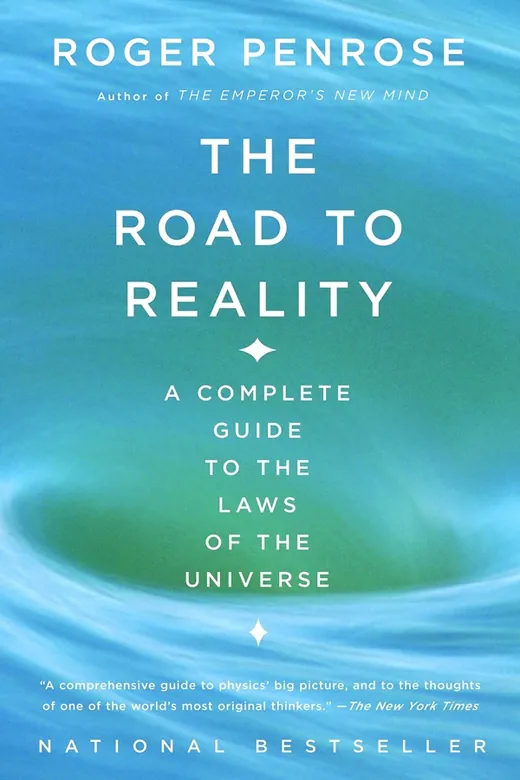
The cover of The Road to Reality

The Road to Reality

What are the underlying principles that govern our universe, and how far can mathematics take you toward understanding them?

At a glance

Author
Roger Penrose

Why read it

  • You will learn the genuine mathematics behind modern physics, from complex numbers to curved geometry, rather than a watered down picture
  • You will weigh the optimistic view that science is close to a basic understanding of all the principles of physics
  • You will see why the author doubts that string theory can reproduce Einstein's picture of space and time

Who it is for

  • A curious reader willing to meet real mathematics
  • A physics student wanting the big picture
  • An engineer who wants to understand the laws of nature

Contents

  1. Preface
  2. Notation
  3. Prologue
  4. 1.1 The quest for the forces that shape the world
  5. 1.2 Mathematical truth
  6. 1.3 Is Plato’s mathematical world ‘real’?
  7. 1.4 Three worlds and three deep mysteries
  8. 1.5 The Good, the True, and the Beautiful
  9. 2.1 The Pythagorean theorem
  10. 2.2 Euclid’s postulates
  11. 2.3 Similar-areas proof of the Pythagorean theorem
  12. 2.4 Hyperbolic geometry: conformal picture
  13. 2.5 Other representations of hyperbolic geometry
  14. 2.6 Historical aspects of hyperbolic geometry
  15. 2.7 Relation to physical space
  16. 3.1 A Pythagorean catastrophe?
  17. 3.2 The real-number system
  18. 3.3 Real numbers in the physical world
  19. 3.4 Do natural numbers need the physical world?
  20. 3.5 Discrete numbers in the physical world
  21. 4.1 The magic number ‘i’
  22. 4.2 Solving equations with complex numbers
  23. 4.3 Convergence of power series
  24. 4.4 Caspar Wessel’s complex plane
  25. 4.5 How to construct the Mandelbrot set
  26. 5.1 Geometry of complex algebra
  27. 5.2 The idea of the complex logarithm
  28. 5.3 Multiple valuedness, natural logarithms
  29. 5.4 Complex powers
  30. 5.5 Some relations to modern particle physics
  31. 6.1 What makes an honest function?
  32. 6.2 Slopes of functions
  33. 6.3 Higher derivatives; C∞-smooth functions
  34. 6.4 The ‘Eulerian’ notion of a function?
  35. 6.5 The rules of differentiation
  36. 6.6 Integration
  37. 7.1 Complex smoothness; holomorphic functions
  38. 7.2 Contour integration
  39. 7.3 Power series from complex smoothness
  40. 7.4 Analytic continuation
  41. 8.1 The idea of a Riemann surface
  42. 8.2 Conformal mappings
  43. 8.3 The Riemann sphere
  44. 8.4 The genus of a compact Riemann surface
  45. 8.5 The Riemann mapping theorem
  46. 9.1 Fourier series
  47. 9.2 Functions on a circle
  48. 9.3 Frequency splitting on the Riemann sphere
  49. 9.4 The Fourier transform
  50. 9.5 Frequency splitting from the Fourier transform
  51. 9.6 What kind of function is appropriate?
  52. 9.7 Hyperfunctions
  53. 10.1 Complex dimensions and real dimensions
  54. 10.2 Smoothness, partial derivatives
  55. 10.3 Vector field and 1-forms
  56. 10.4 Components, scalar products
  57. 10.5 The Cauchy–Riemann equations
  58. 11.1 The algebra of quaternions
  59. 11.2 The physical role of quaternions?
  60. 11.3 Geometry of quaternions

More books like this