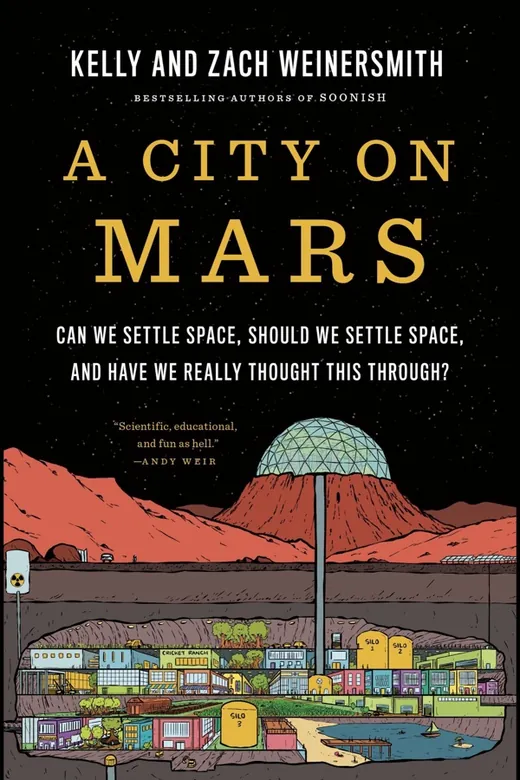
A City on Mars
What would it take to settle beyond Earth? Explore the bodily, ecological, legal, and political hurdles before deciding how soon people should try.
12 parts, about 30 minutes to read.


What would it take to settle beyond Earth? Explore the bodily, ecological, legal, and political hurdles before deciding how soon people should try.
12 parts, about 30 minutes to read.
The Weinersmiths' most controversial conclusion is that permanent space settlement should proceed much more slowly than its advocates often propose. A common objection is that delay sacrifices exploration, commercial momentum, and a possible refuge from disasters on Earth. The authors respond that a settlement cannot serve as a reliable refuge until it can survive without fragile supply chains, uncertain reproduction, and political support from Earth. They also distinguish scientific missions and limited habitation from the stronger claim that large, independent communities are ready now. Their argument accumulates uncertainty across physiology, pregnancy, radiation, agriculture, law, labor, and international conflict rather than identifying one impossible barrier. The dispute is therefore about the burden of proof: enthusiasts treat unsolved problems as invitations to build, while the book treats human experimentation and geopolitical stakes as reasons to establish more evidence first.
 A Beautiful MindNasar, Sylvia
 A Beautiful QuestionFrank Wilczek
 A Brief History of TimeStephen Hawking
 A Mathematician’s ApologyG. H. Hardy
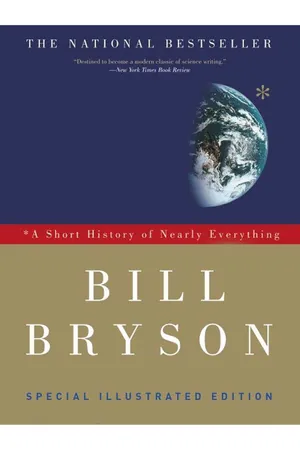 A Short History of Nearly EverythingBill Bryson
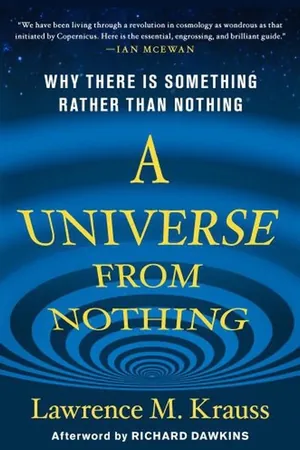 A Universe From Nothing · Why There Is Something Rather Than NothingKrauss, Lawrence M.
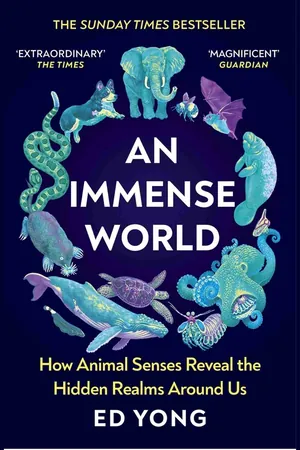 An Immense WorldEd Yong
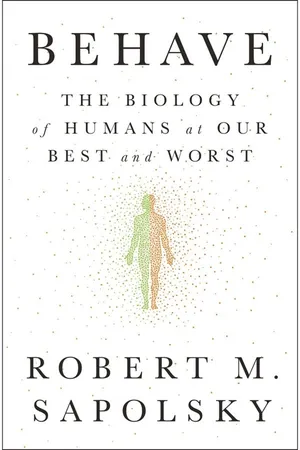 BehaveRobert M. Sapolsky
 Black Hole Blues and Other Songs from Outer SpaceLevin, Janna
 BlueprintRobert Plomin
 Braiding SweetgrassRobin Wall Kimmerer
 BurnHerman Pontzer