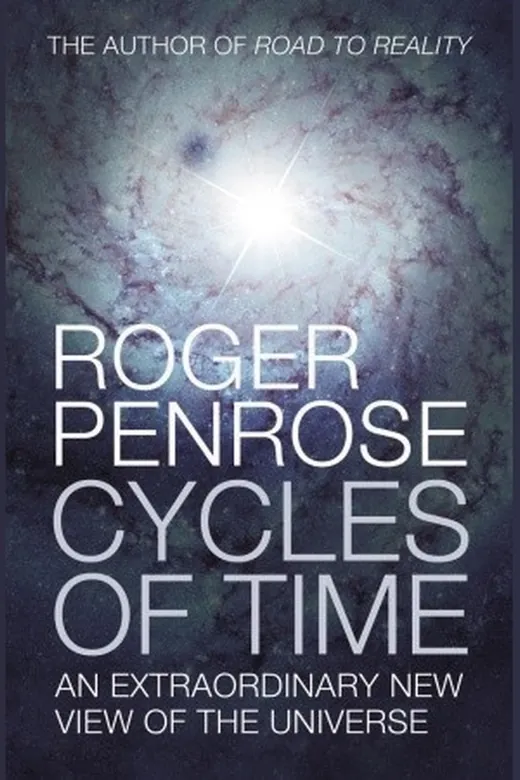
The cover of Cycles of Time: An Extraordinary New View of the Universe

Cycles of Time: An Extraordinary New View of the Universe

Where did our universe come from, and why did it start out so extraordinarily ordered, a puzzle Penrose answers with a new picture of one universe following another?

At a glance

Author
Roger Penrose

Why read it

  • You will see why the Big Bang is considered strangely special, an unexpectedly orderly start
  • You will get a working feel for entropy and why a broken egg does not put itself back together
  • You will be able to weigh a proposal that our universe is one stage of a cycle, and ask what evidence could test it

Who it is for

  • Science fans who want the big picture of cosmology and time
  • Anyone who has wondered why time only runs one way
  • Students who want a physicist's own view of how the universe began

Contents

  1. A Note on the eBook
  2. Preface
  3. Prologue
  4. Cycles of Time
  5. An Extraordinary New View of the Universe
  6. Part 1
  7. The Second Law and its underlying mystery
  8. 1.1 The relentless march of randomness
  9. 1.2 Entropy, as state counting
  10. 1.3 Phase space, and Boltzmann’s definition of entropy
  11. 1.4 The robustness of the entropy concept
  12. 1.5 The inexorable increase of entropy into the future
  13. 1.6 Why is the past different?
  14. Part 2
  15. The oddly special nature of the Big Bang
  16. 2.1 Our expanding universe
  17. 2.2 The ubiquitous microwave background
  18. 2.3 Space-time, null cones, metrics, conformal geometry
  19. 2.4 Black holes and space-time singularities
  20. 2.5 Conformal diagrams and conformal boundaries
  21. 2.6 Understanding the way the Big Bang was special
  22. Part 3
  23. Conformal cyclic cosmology
  24. 3.1 Connecting with infinity
  25. 3.2 The structure of CCC
  26. 3.3 Earlier pre-Big-Bang proposals
  27. 3.4 Squaring the Second Law
  28. 3.5 CCC and quantum gravity
  29. 3.6 Observational implications
  30. Epilogue
  31. Appendix A: Conformal rescaling, 2-spinors, Maxwell and Einstein theory
  32. A1. The 2-spinor notation: Maxwell equations
  33. A2. Massless free-field (‘Schrödinger’) equation
  34. A3. Space-time curvature quantities
  35. A4. Massless gravitational sources
  36. A5. Bianchi identities
  37. A6. Conformal rescalings
  38. A7. Yang–Mills fields
  39. A8. Scaling of zero rest-mass energy tensors
  40. A9. Weyl tensor conformal scalings
  41. Appendix B: Equations at crossover
  42. B1. The metrics ĝab, ab, and ğab
  43. B2. Equations for
  44. B3. The role of the phantom field
  45. B4. The normal N to
  46. B5. Event horizon area
  47. B6. The reciprocal proposal
  48. B7. Dynamics across
  49. B8. Conformally invariant Dab operator
  50. B9. Keeping the gravitational constant positive
  51. B10. To eliminate spurious g-metric freedom
  52. B11. The matter content of
  53. B12. Gravitational radiation at

More books like this