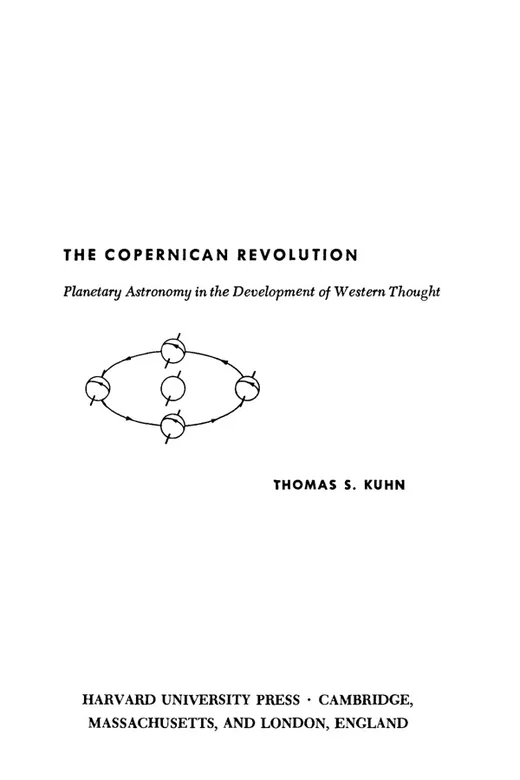
The cover of The Copernican Revolution: Planetary Astronomy in the Development of Western Thought

The Copernican Revolution: Planetary Astronomy in the Development of Western Thought

How did the idea that the earth moves overturn a whole picture of the world, not just astronomy?

At a glance

Author
Kuhn, Thomas S.

Why read it

  • You will see how a belief that fits everything you know can blind you to alternatives
  • You will learn how a change in one field forces change in others, so big ideas rarely travel alone
  • You will understand why a new theory can look no better than the old one at first, yet pull ahead once harder problems are added

Who it is for

  • Readers curious how scientific revolutions actually happen
  • Professionals facing a shift their old frame cannot explain
  • Students of science, history or the philosophy of ideas

Contents

  1. Preface
  2. Foreword
  3. 1. The Ancient Two-Sphere Universe
  4. Copernicus and the Modern Mind
  5. The Heavens in Primitive Cosmologies
  6. The Apparent Motion of the Sun
  7. The Stars
  8. The Sun as a Moving Star
  9. The Birth of Scientific Cosmology - The Two-Sphere Universe
  10. The Sun in the Two-Sphere Universe
  11. The Functions of a Conceptual Scheme
  12. Ancient Competitors of the Two-Sphere Universe
  13. 2. The Problem of the Planets
  14. Apparent Planetary Motion
  15. The Location of the Planets
  16. The Theory of Homocentric Spheres
  17. Epicycles and Deferents
  18. Ptolemaic Astronomy
  19. The Anatomy of Scientific Belief
  20. 3. The Two-Sphere Universe in Aristotelian Thought
  21. The Aristotelian Universe
  22. The Aristotelian Laws of Motion
  23. The Aristotelian Plenum
  24. The Majesty of the Heavens
  25. The Aristotelian World View in Perspective
  26. 4. Recasting the Tradition: Aristotle to the Copernicans
  27. European Science and Learning to the Thirteenth Century
  28. Astronomy and the Church
  29. Aristotle's Scholastic Critics
  30. Astronomy in the Age of Copernicus
  31. 5. Copernicus' Innovation
  32. Copernicus and the Revolution
  33. Motives for Innovation - Copernicus' Preface
  34. Copernicus' Physics and Cosmology
  35. Copernican Astronomy - The Two Spheres
  36. Copernican Astronomy - The Sun
  37. Copernican Astronomy - The Planets
  38. The Harmony of the Copernican System
  39. Revolution by Degrees
  40. 6. The Assimilation of Copernican Astronomy
  41. The Reception of Copernicus' Work
  42. Tycho Brahe
  43. Johannes Kepler
  44. Galileo Galilei
  45. The Decline of Ptolemaic Astronomy
  46. 7. The New Universe
  47. The New Scientific Perspective
  48. Toward an Infinite Universe
  49. The Corpuscular Universe
  50. The Mechanical Solar System
  51. Gravity and the Corpuscular Universe
  52. The New Fabric of Thought
  53. Technical Appendix
  54. 1. Correcting Solar Time
  55. 2. Precession of the Equinoxes
  56. 3. Phases of the Moon and Eclipses
  57. 4. Ancient Measurements of the Universe
  58. Bibliographical Notes

More books like this