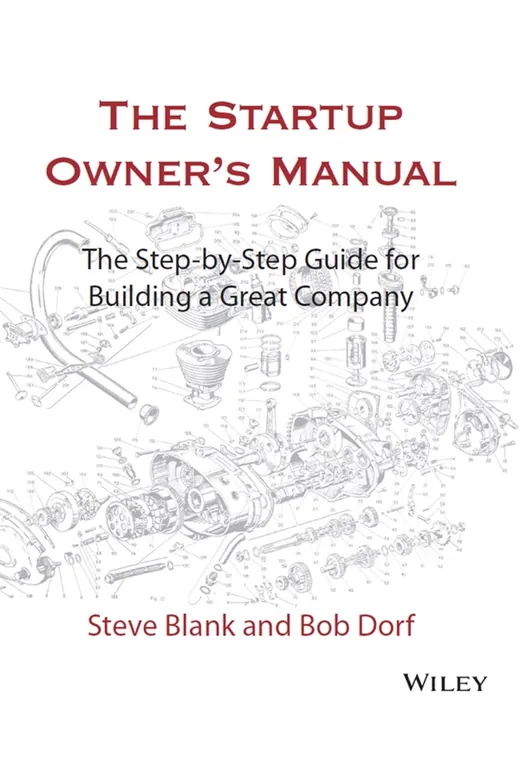
The cover of The Startup Owner's Manual

The Startup Owner's Manual

Why does the business school playbook for big companies fail startups, and what should founders do in its place?

At a glance

Author
Steve Blank, Bob Dorf

Why read it

  • You will understand that a startup searches for a repeatable, profitable business model instead of executing a known one
  • You will stop expecting a startup to execute its business plan, since none ever does
  • You will learn to test whether customers care by using fake sign up forms and simple websites

Who it is for

  • A first time founder with an idea and no customers yet
  • An investor reviewing startups that miss their business plans
  • A corporate innovator launching a new product line

Contents

  1. How to Read This Book
  2. Organization
  3. Web/Mobile vs. Physical Channels
  4. Paths Through This Book
  5. A Few Helpful Tips
  6. Preface
  7. Who Is This Book For?
  8. Who Is This Book Not For?
  9. Introduction
  10. A Repeatable Path
  11. Why a Second Decade?
  12. The Four Steps: A New Path
  13. I Getting Started
  14. CHAPTER 1 The Path to Disaster: A Startup Is Not a Small Version of a Big Company
  15. The Traditional New-Product Introduction Model
  16. The 9 Deadly Sins of the New Product Introduction Model
  17. CHAPTER 2 The Path to the Epiphany: The Customer Development Model
  18. An Introduction to Customer Development
  19. “The Search for a Business Model:” Steps, Iteration and Pivots
  20. A Customer Development Bonus: Minimum Waste of Cash and Time
  21. The Customer Development Manifesto
  22. Summary: The Customer Development Process
  23. II Step One: Customer Discovery
  24. CHAPTER 3 An Introduction to Customer Discovery
  25. The Customer Discovery Philosophy
  26. CHAPTER 4 Customer Discovery, Phase One: State Your Business Model Hypotheses
  27. Market Size Hypothesis (Physical and Web/Mobile)
  28. Value Proposition 1: “Low Fidelity” MVP Hypothesis (Web/Mobile)
  29. Customer Segments: Who/Problem Hypothesis (Physical)
  30. Customer Segments: Source/Wiring Hypothesis (Web/Mobile)
  31. Channels Hypothesis (Physical)
  32. Channels Hypothesis (Web/Mobile)
  33. Value Proposition 2: Market-Type and Competitive Hypothesis
  34. Customer Relationships Hypothesis (Web/Mobile)
  35. Key Resources Hypothesis (Physical and Web/Mobile)
  36. Partners Hypothesis (Physical)
  37. Traffic Partners Hypothesis (Web/Mobile)
  38. Revenue and Pricing Hypothesis
  39. CHAPTER 5 Customer Discovery, Phase Two: “Get Out of the Building” to Test the Problem: “Do People Care?”
  40. Design Tests and Pass/Fail Experiments
  41. Prepare for Customer Contacts (Physical)
  42. Build Your Low Fidelity MVP (Web/Mobile)
  43. Test Understanding of the Problem and Assess Its Importance (Physical)
  44. Avoid the Big-Company Meeting Trap
  45. Low Fidelity MVP Problem Test (Web/Mobile)
  46. Missteps to Avoid when Testing the Low Fidelity MVP:
  47. Gain Customer Understanding
  48. Capture Market Knowledge (Physical)
  49. Traffic/Competitive Analysis (Web/Mobile)
  50. CHAPTER 6 Customer Discovery, Phase Three: “Get Out of the Building” and Test the Product Solution
  51. Update the Business Model and Team (a Pivot-or-Proceed Point)
  52. Create the Product “Solution” Presentation (Physical)
  53. High Fidelity MVP Test (Web/Mobile)
  54. Test the Product Solution with the Customer (Physical)
  55. Measure Customer Behavior (Web/Mobile)
  56. Update the Business Model Again
  57. Identify First Advisory Board Members
  58. CHAPTER 7 Customer Discovery, Phase Four: Verify the Business Model and Pivot or Proceed
  59. Have We Found a Product/Market Fit?
  60. Do We Know Who Our Customers Are and How to Reach Them?

More books like this