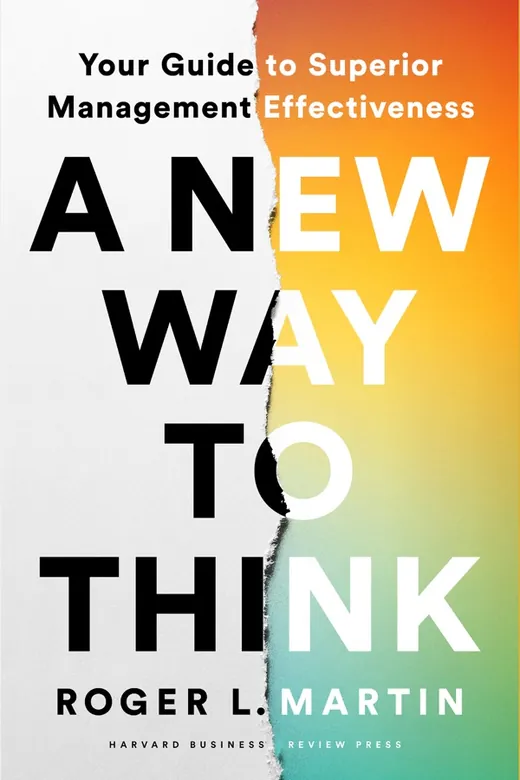
The cover of A New Way to Think

A New Way to Think

Why do familiar management models keep failing, and what better models can you try for strategy, customers and choices?

At a glance

Author
Roger L. Martin

Why read it

  • You will stop blaming yourself when a standard management model fails, and ask whether the model is at fault
  • You will learn to build a strategy by asking what would have to be true for a choice to work
  • You will learn why great choices call for imagination as much as for data

Who it is for

  • An executive whose strategy planning has become a spreadsheet ritual
  • A manager told to push harder when a method keeps failing
  • A consultant who wants a sharper way to frame a client's problem

The idea people argue about

Martin's most debatable management claim is that putting customers first is a better route to durable shareholder returns than directly maximizing shareholder value. A common objection is that managers are legally and financially accountable to owners, while customer benefit is difficult to measure and may excuse weak returns. Martin answers causally: shareholders receive the residual result, but satisfied customers generate the revenue from which that result can emerge. He argues that treating the stock price as the direct target encourages short horizons, expectations games, and value extraction rather than better offerings. The claim does not make profit optional or give managers permission to pursue any favored purpose. It rearranges means and ends, asking leaders to make competitive customer value the operating objective and to evaluate shareholder gains as an outcome that cannot be sustained when the underlying customer relationship deteriorates.

Three common misunderstandings

  1. The models in the book are not universal formulas to be installed without diagnosis. Martin presents familiar frameworks as answers to specific questions and asks managers to examine the assumptions that make each model useful or misleading.
  2. Strategy is not reduced to collecting more data until the correct choice becomes completely obvious. Martin treats strategy as an integrated set of choices and recommends asking what would have to be true, which exposes assumptions that evidence can then test.
  3. Efficiency does not always mean cutting staff, layers, inventory, or slack as far as possible. The book examines how resilience, learning, customer service, and adaptability can be destroyed when a narrow measure of efficiency ignores the system's purpose.

Contents

  1. Introduction
  2. Thinking Differently about the Essentials of Management
  3. Models, Harvard Business Review, and a Book
  4. On Context
  5. Making Choices
  6. Structuring Work
  7. Key Activities
  8. PART ONE On Context
  9. Competition
  10. It happens at the front line, not at the head office.
  11. From Optimal Hierarchy …
  12. … to Organizing for Value
  13. A High Bar
  14. Creating a Theory for the Firm
  15. Stakeholders
  16. To actually create shareholder value, put customers before shareholders.
  17. The Flawed Logic of Shareholder Value
  18. Let the Customers Take Over
  19. The Principle at Work
  20. Customers
  21. The familiar solution usually trumps the perfect one.
  22. Creatures of Habit
  23. A Complement to Choice
  24. The Cumulative Advantage Imperatives
  25. PART TWO Making Choices
  26. Strategy
  27. In strategy, what counts is what would have to be true—not what is true.
  28. Step 1: Move from Issues to Choice
  29. Step 2: Generate Strategic Possibilities
  30. Step 3: Specify the Conditions for Success
  31. Step 4: Identify the Barriers to Choice
  32. Step 5: Design Tests for the Barrier Conditions
  33. Step 6: Conduct the Tests
  34. Step 7: Make the Choice
  35. Data
  36. Creating great choices requires imagination more than data.
  37. Is Business a Science?
  38. Can or Cannot?
  39. Breaking the Frame
  40. Constructing Persuasive Narratives
  41. Picking the Right Metaphor
  42. Making Your Choice
  43. PART THREE Structuring Work
  44. Culture
  45. You can only change it by altering how individuals work with one another.
  46. Organizational Steering Mechanisms
  47. A Derivative Construct
  48. How to Change Culture Indirectly
  49. Creating a Winning Culture at the Rotman School
  50. Knowledge Work
  51. You must organize around projects, not jobs.
  52. The Rise of the Decision Factory
  53. Productivity in the Decision Factory
  54. Redefining the Job Contract
  55. Toward the Knowledge Algorithm
  56. Corporate Functions
  57. Give them their own strategies.
  58. What Happens If You Don’t Choose a Strategy?
  59. How to Create Effective Functional Strategy
  60. Talent Strategy at Four Seasons

More books like this