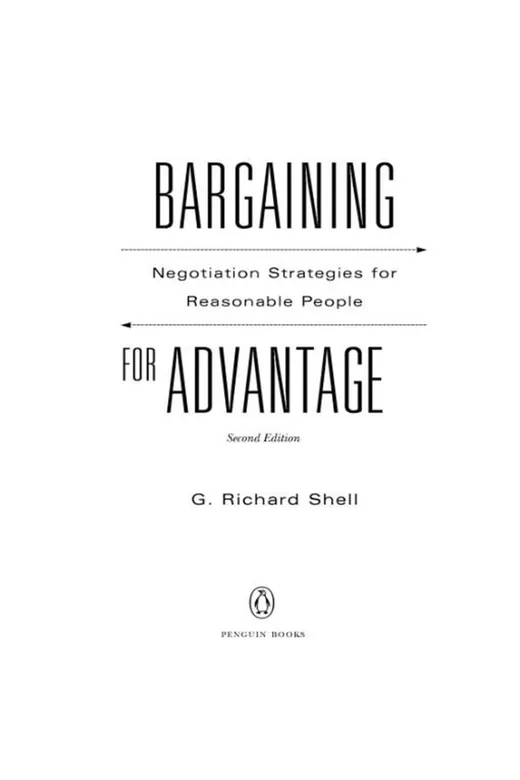
The cover of Bargaining for Advantage

Bargaining for Advantage

How can you prepare for and run a negotiation, in any style, so you reach a good deal without losing your integrity?

At a glance

Author
G. Richard Shell

Why read it

  • You will set a specific, hopeful goal before you bargain instead of only a bottom line
  • You will learn why people want to look reasonable and how to use fair standards to move a deal
  • You will spot the traps that catch reasonable, relationship minded people, including common lies about bottom lines

Who it is for

  • A manager preparing for a pay, contract or supplier talk
  • Someone who dreads asking for more
  • A professional who negotiates often but never trained

Contents

  1. Introduction:
  2. Look Inside Your Toolbox: It’s Your Move
  3. The Approach: Information-Based Bargaining
  4. You Can Learn Only by Doing
  5. PART I - THE SIX FOUNDATIONS OF EFFECTIVE NEGOTIATION
  6. Talking to the Mountain
  7. The Path of Negotiation
  8. We Are All Negotiators
  9. What’s Your Style?
  10. Five Strategies and Negotiation Styles: A Thought Experiment
  11. Cooperative Versus Competitive Styles
  12. Gender and Culture
  13. THE GENDER DIFFERENCE IN NEGOTIATION
  14. A WORLD OF DIFFERENT CULTURES
  15. Beyond Style—to Effectiveness
  16. A WILLINGNESS TO PREPARE
  17. HIGH EXPECTATIONS
  18. THE PATIENCE TO LISTEN
  19. A COMMITMENT TO PERSONAL INTEGRITY
  20. From Manhattan to Mount Meru
  21. Summary
  22. Goals: You’ll Never Hit the Target if You Don’t Aim
  23. Goals Versus “Bottom Lines”
  24. What Do You Really Want?
  25. Set an Optimistic, Justifiable Target
  26. Be Specific
  27. Commit to Your Goal: Write It Down and Talk About It
  28. Carry Your Goals with You into the Negotiation
  29. Summary
  30. The Story of the Two Pigs
  31. From Pigs to Price Lists: The Role of Standards
  32. A Psychological Fact: We All Want to Appear Reasonable
  33. The Consistency Principle and “Normative Leverage”
  34. Beware of “Consistency Traps”
  35. Using Audiences
  36. Mahatma Gandhi Rides First-class
  37. Standards and Norms in Markets
  38. Positioning Themes: “Part-time America Won’t Work”
  39. The Power of Authority
  40. Summary
  41. The Norm of Reciprocity
  42. J. P. Morgan Makes a Friend
  43. The “Ultimatum Game”: A Test of Fairness
  44. The Relationship Factor in Negotiation Planning
  45. Personal Relationships Versus Working Relationships
  46. Psychological Strategies for Building Working Relationships
  47. THE SIMILARITY PRINCIPLE
  48. THE ROLE OF GIFTS AND FAVORS
  49. TRUST AND RELATIONSHIP NETWORKS
  50. Relationship Traps for the Unwary
  51. TRUSTING TOO QUICKLY
  52. RECIPROCITY TRAPS
  53. NEGOTIATING WITH FRIENDS WHEN THE STAKES ARE HIGH
  54. Summary
  55. Discover the Other Party’s Goals
  56. The Planning Behavior of Skilled Negotiators
  57. Identify the Decision Maker
  58. Look for Common Ground: How Might It Serve the Other Party’s Interests to Help You Achieve Your Goals?
  59. Identify Interests That Might Interfere with Agreement: Why Might the Other Party Say “No”?
  60. Search for Low-Cost Options That Solve the Other Party’s Problems While Advancing Your Goals

More books like this