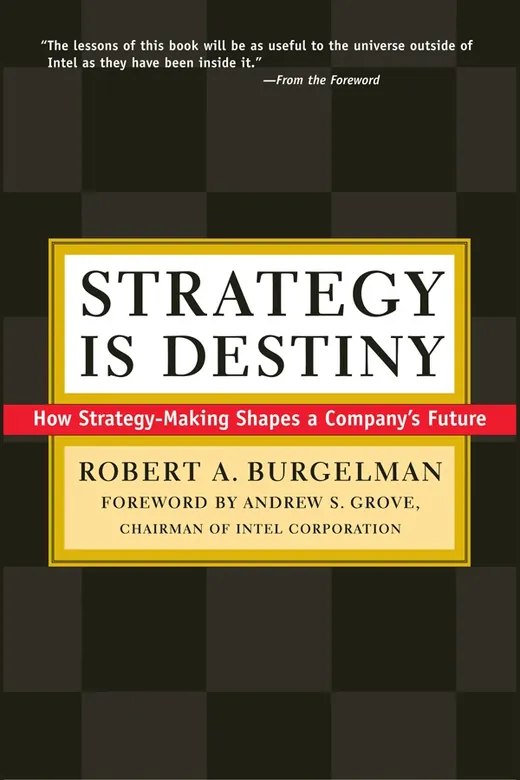
The cover of Strategy Is Destiny

Strategy Is Destiny

Why are some firms extraordinarily successful during part of their history?

At a glance

Author
Robert A. Burgelman

Why read it

  • You will see how a firm can learn its real strengths by exiting a business, as Intel did when it left memory chips for microprocessors
  • You will understand how success tied to one market can harden into strategic inertia
  • You will weigh how a strong top down strategy keeps a firm focused while leaving some room for bottom up initiatives

Who it is for

  • An executive whose core business is being overtaken by another
  • A strategy student studying how one firm reinvented itself
  • A manager who sees past success making her firm rigid

Contents

  1. FOREWORD Reflections of Andy Grove
  2. PREFACE
  3. READER’S GUIDE
  4. Introduction: An Evolutionary Perspective on Strategy-Making
  5. 1 STRATEGY IS DESTINY
  6. Epoch I: Intel the Memory Company
  7. 2 GENESIS AND TRANSFORMATION
  8. 3 DYNAMIC FORCES DRIVING COMPANY EVOLUTION
  9. 4 COEVOLUTION OF GENERIC AND SUBSTANTIVE STRATEGIES
  10. 5 INTERNAL ECOLOGY OF STRATEGY-MAKING
  11. Epoch II: Intel the Microprocessor Company
  12. 6 CREATING A STRATEGY VECTOR: INDUCED STRATEGIC ACTION
  13. 7 FACING A STRATEGY VECTOR: AUTONOMOUS STRATEGIC ACTION
  14. 8 COEVOLUTION OF STRATEGY AND ENVIRONMENT
  15. 9 COEVOLUTION AND STRATEGIC INERTIA
  16. Epoch III: Intel the Internet Building Block Company
  17. 10 MAINTAINING AND EXTENDING THE STRATEGY VECTOR
  18. 11 DESIGNING THE INTERNAL ECOLOGY OF STRATEGY-MAKING
  19. Conclusion: Implications for Strategic Leadership
  20. 12 FOUR STRATEGIC LEADERSHIP IMPERATIVES
  21. APPENDIX I Research Method
  22. APPENDIX II Financial Highlights of Intel’s Evolution
  23. APPENDIX III New Business Development in Established Companies¹

More books like this