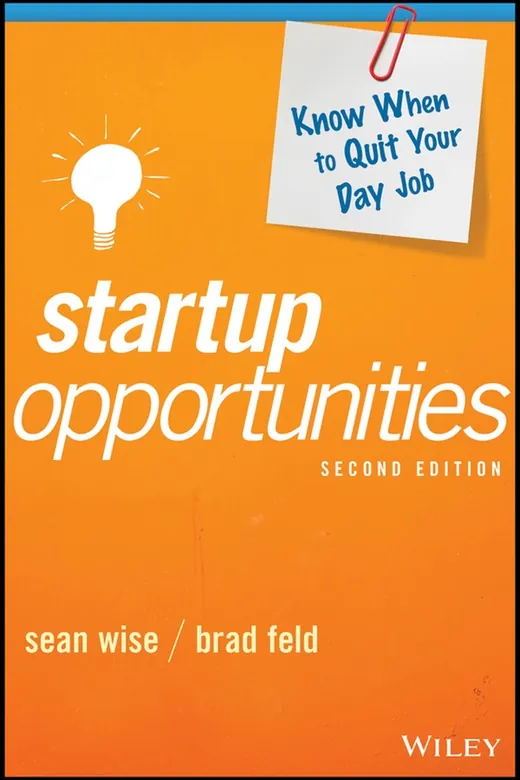
The cover of Startup Opportunities

Startup Opportunities

How do you tell whether a flash of startup inspiration is a real opportunity worth years of your work?

At a glance

Author
Brad Feld, Sean Wise

Why read it

  • You will judge a startup by its people first, from passion and coachability to domain knowledge, before judging the idea
  • You will weigh honestly whether you can sustain years of hard work in a startup
  • You will learn to match the kind of investor to the stage your company has reached

Who it is for

  • An employee with a business idea deciding whether to quit
  • A first time founder preparing to approach investors
  • A mentor judging founders and the ideas they bring

Contents

  1. Foreword
  2. Preface
  3. Trust Me, Your Idea Is Worthless
  4. CHAPTER 1 What Is a Startup?
  5. How to Use This Book
  6. Who This Book Is For
  7. CHAPTER 2 The Democratization of Startups
  8. The Cost to Launch Is Approaching Zero
  9. The World Is Flat
  10. The Path Is Known
  11. Access to Capital
  12. CHAPTER 3 Opportunities
  13. The Four Criteria for an Opportunity
  14. What Is Opportunity Evaluation?
  15. What Is the Cost of Poor Opportunity Evaluation?
  16. Execution Trumps Opportunity
  17. Risk, Uncertainty, and Ambiguity
  18. The Issue of Bias
  19. Killer Bias: Psychological Traps That Catch Entrepreneurs and Investors
  20. CHAPTER 4 Approaches to Opportunity Evaluation
  21. Where Does Opportunity Evaluation Fit into the Overall Startup Process?
  22. Overview of Business Model Generation
  23. Overview of Customer Development and Lean Startup
  24. Overview of the Disciplined Entrepreneur
  25. A Modern Version of the Scientific Method
  26. CHAPTER 5 People
  27. Team
  28. Working Full Time
  29. Been There, Done That
  30. Passion
  31. Coachability
  32. Ability to Attract Talent
  33. Business Acumen
  34. Domain Knowledge
  35. Operational Experience
  36. Mentors
  37. Board of Directors/Advisors
  38. Customers
  39. Social Capital
  40. CHAPTER 6 Pain
  41. Compelling Unmet Need
  42. Size
  43. Durability and Timeliness
  44. CHAPTER 7 Product
  45. The 10× Rule
  46. Rate of Adoption
  47. Rogers’ Diffusion of Innovations Theory
  48. Intellectual Property
  49. Key Asset Access
  50. Proof of Concept—Selling Your Product in Advance of Making It
  51. Gross Margins
  52. Scalability
  53. CHAPTER 8 Market
  54. Market Stage
  55. Product/Market Fit
  56. Disruptive Innovation
  57. Industry CAGR
  58. Distribution Strength
  59. Customer Acquisition Costs
  60. Viral Marketing

More books like this