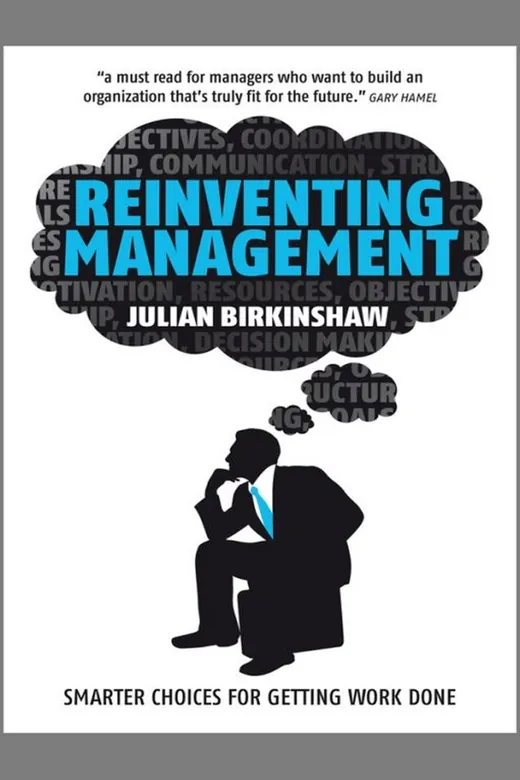
The cover of Reinventing Management

Reinventing Management

What is management, why does it matter, and how can reinventing it give your company a competitive advantage?

At a glance

Author
Julian Birkinshaw

Why read it

  • You will question the belief that management is simple and timeless, since its methods have changed dramatically even when its functions have not
  • You will weigh the author's claim that leaders have neglected getting work done, so that management ability has been scarce
  • You will understand why bureaucracy began as the antidote to bad management, before it came to be tainted

Who it is for

  • A manager who thinks leadership matters more than management
  • An executive rethinking how work gets coordinated
  • A consultant looking for management model innovations

Contents

  1. Preface
  2. Lehman Brothers’ Demise
  3. General Motors’ Bankruptcy
  4. Disenchantment with Management
  5. The Corruption of Management
  6. Management in a Changing World
  7. Reinventing Management
  8. The Key Messages in this Book
  9. Lehman Brothers and GM Revisited
  10. Building Competitive Advantage through Management Model Innovation
  11. Defining What a Management Model Is
  12. Organizing Framework: Four Dimensions, Eight Principles
  13. Same As It Ever Was?
  14. Follow the Trend or Stick to the Knitting?
  15. Your Turn
  16. Bureaucracy is not a Four-letter Word
  17. Emergence
  18. Bureaucracy and Emergence-a Never-ending Dance
  19. Flexible Bureaucracy
  20. Internal Market Model
  21. Network Model
  22. Some Final Points
  23. What is Hierarchy?
  24. Collective Wisdom
  25. Communicating with Subordinates
  26. Gaining Input from Subordinates on Decisions
  27. Using Subordinates to Solve Problems and Innovate
  28. Making Use of External Input to Improve Decision-making
  29. Some Final Points
  30. The Tyranny of Alignment
  31. The Value of Obliquity
  32. Three Approaches to Obliquity
  33. Approach #1: Pursuing an Indirect Goal
  34. Approach #2: Pursuing a Creative Goal
  35. Approach #3: Taking a Leap of Faith
  36. Some Final Points
  37. Some Historical Background
  38. Material Drivers
  39. Social Drivers
  40. Personal Drivers
  41. Some Final Points
  42. Diagnosing Your Company’s Management Model
  43. The Discovery Model: Google
  44. The Planning Model: McDonald’s Corporation
  45. The Quest Model: Investment Banking
  46. The Science Model: Arup
  47. Some Final Points
  48. Microsoft and the 42Projects Experiment
  49. UBS and the Idea Exchange
  50. Five Lessons for Change Agents
  51. Four Steps to Innovating Your Management Model
  52. 1. Understanding: Framing the Challenge
  53. 2. Evaluating: Defining the Blockers
  54. 3. Envisioning: Identifying New Ways of Working
  55. 4. Experimenting: Trying It Out and Monitoring Progress
  56. Some Final Points
  57. Epilogue
  58. A Broader Discussion
  59. The Business Community Agenda
  60. The Policy Agenda

More books like this