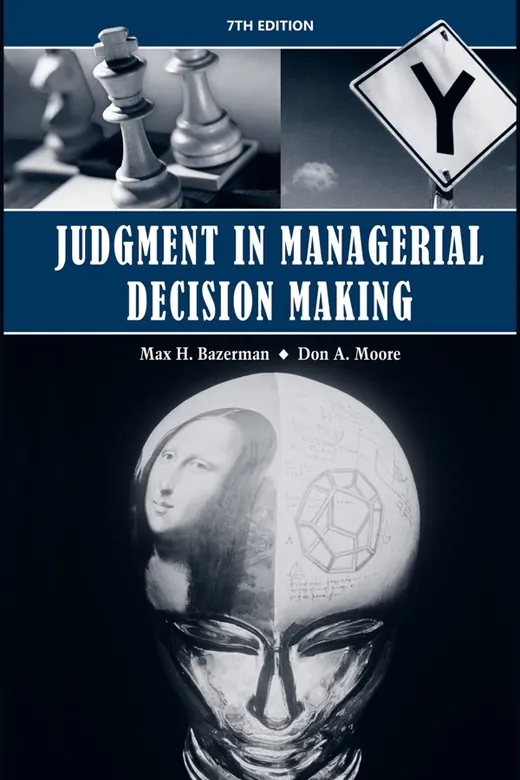
The cover of Judgment in Managerial Decision Making

Judgment in Managerial Decision Making

How can managers recognize the biases that distort their judgments, and which strategies correct them?

At a glance

Author
Max H. Bazerman, Don A. Moore

Why read it

  • You will recognize the mental shortcuts behind common biases, such as judging by what comes easily to mind, before they distort your decisions
  • You will notice when you keep escalating commitment to a failing course of action just because you have already invested in it
  • You will know that reading about bias is not enough, and keep reviewing your own decisions for these errors until better habits stick

Who it is for

  • A manager making budget and hiring decisions under pressure
  • A negotiator who wants to avoid costly mistakes
  • A student of psychology or economics seeking applied judgment

Contents

  1. Preface
  2. Chapter 1: Introduction to Managerial Decision Making
  3. The Anatomy of Decisions
  4. System 1 and System 2 Thinking
  5. The Bounds of Human Rationality
  6. Introduction to Judgmental Heuristics
  7. An Outline of Things to Come
  8. Chapter 2: Common Biases
  9. Biases Emanating from the Availability Heuristic
  10. Biases Emanating from the Representativeness Heuristic
  11. Biases Emanating from the Confirmation Heuristic
  12. Integration and Commentary
  13. Chapter 3: Bounded Awareness
  14. Inattentional Blindness
  15. Change Blindness
  16. Focalism and the Focusing Illusion
  17. Bounded Awareness in Groups
  18. Bounded Awareness in Strategic Settings
  19. Bounded Awareness in Auctions
  20. Discussion
  21. Chapter 4: Framing and the Reversal of Preferences
  22. Framing and the Irrationality of the Sum of Our Choices
  23. We Like Certainty, Even Pseudocertainty
  24. The Framing and the Overselling of Insurance
  25. What’s It Worth to You?
  26. The Value We Place on What We Own
  27. Mental Accounting
  28. Do No Harm, the Omission Bias, and the Status Quo
  29. Rebate/Bonus Framing
  30. Joint Versus Separate Preference Reversals
  31. Conclusion and Integration
  32. Chapter 5: Motivational and Emotional Influences on Decision Making
  33. When Emotion and Cognition Collide
  34. Positive Illusions
  35. Self-Serving Reasoning
  36. Emotional Influences on Decision Making
  37. Summary
  38. Chapter 6: The Escalation of Commitment
  39. The Unilateral Escalation Paradigm
  40. The Competitive Escalation Paradigm
  41. Why Does Escalation Occur?
  42. Integration
  43. Chapter 7: Fairness and Ethics in Decision Making
  44. Perceptions of Fairness
  45. Bounded Ethicality
  46. Conclusion
  47. Chapter 8: Common Investment Mistakes
  48. The Psychology of Poor Investment Decisions
  49. Active Trading
  50. Action Steps
  51. Chapter 9: Making Rational Decisions in Negotiations
  52. A Decision-Analytic Approach to Negotiations
  53. Claiming Value in Negotiation
  54. Creating Value in Negotiation
  55. The Tools of Value Creation
  56. Summary and Critique
  57. Chapter 10: Negotiator Cognition
  58. The Mythical Fixed Pie of Negotiation
  59. The Framing of Negotiator Judgment
  60. Escalation of Conflict

More books like this