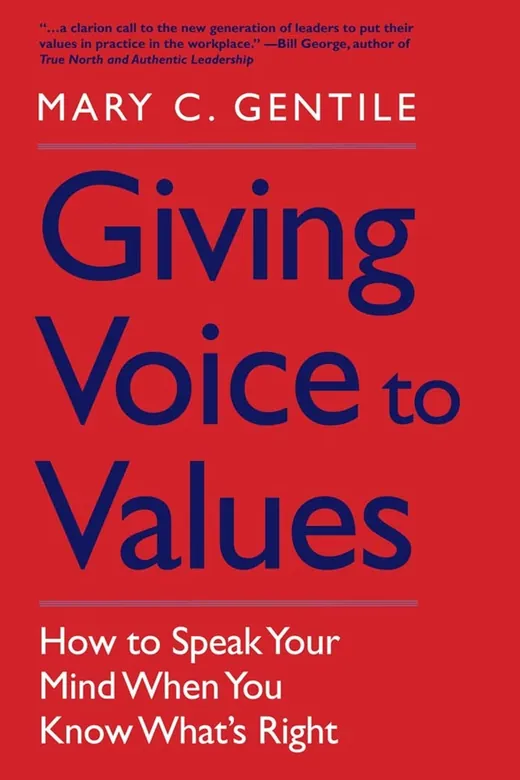
The cover of Giving Voice to Values

Giving Voice to Values

How can you act on your values at work, when you already believe something is wrong, instead of staying silent?

At a glance

Author
Mary C. Gentile

Why read it

  • You will learn that voice is built through practice, so rehearsing your words ahead of time makes you more likely to speak
  • You will be able to answer the common rationalizations for questionable behavior, because they are predictable
  • You will expect values conflicts as a normal part of work, so you meet them calmly instead of overreacting and narrowing your options

Who it is for

  • A junior analyst asked to sign off on numbers that feel wrong
  • A manager who wants a team able to speak up
  • A new graduate preparing for a first clash of values

Contents

  1. Preface
  2. MISSING THE FOREST FOR THE “BAD APPLES”
  3. About This Book
  4. Introduction
  5. The Origins of Giving Voice to Values
  6. How This Book Is Organized
  7. CHAPTER 1 GIVING VOICE TO OUR VALUES: THE THOUGHT EXPERIMENT
  8. CHAPTER 2 VALUES: WHAT THEY ARE AND WHAT THEY ARE NOT
  9. CHAPTER 3 A TALE OF TWO STORIES: THE POWER OF CHOICE
  10. CHAPTER 4 IT’S ONLY NORMAL
  11. CHAPTER 5 WHAT AM I WORKING FOR?
  12. CHAPTER 6 PLAYING TO MY STRENGTHS: SELF-KNOWLEDGE, SELF-IMAGE, AND ALIGNMENT
  13. CHAPTER 7 FINDING MY VOICE
  14. CHAPTER 8 REASONS AND RATIONALIZATIONS
  15. CHAPTER 9 PUTTING IT TO WORK
  16. CHAPTER ONE
  17. Giving Voice to Our Values
  18. THE THOUGHT EXPERIMENT
  19. Assumption One: I want to voice and act upon my values.
  20. Assumption Two: I have voiced my values, at some points in my past.
  21. Assumption Three: I can voice my values more often and more effectively.
  22. Assumption Four: It is easier for me to voice my values in some contexts than others.
  23. Assumption Five: I am more likely to voice my values if I have practiced how to respond to frequently encountered conflicts.
  24. Assumption Six: My example is powerful.
  25. Assumption Seven: Although mastering and delivering responses to frequently heard rationalizations can empower others who share my views to act, I cannot assume I know who those folks will be.
  26. Assumption Eight: The better I know myself, the more I can prepare to play to my strengths and, when necessary, protect myself from my weaknesses.
  27. Assumption Nine: I am not alone.
  28. Assumption Ten: Although I may not always succeed, voicing and acting on my values is worth doing.
  29. Assumption Eleven: Voicing my values leads to better decisions.
  30. Assumption Twelve: The more I believe it’s possible to voice and act on my values, the more likely I will be to do so.
  31. CHAPTER TWO
  32. Values
  33. WHAT THEY ARE AND WHAT THEY ARE NOT
  34. CHAPTER THREE
  35. A Tale of Two Stories
  36. THE POWER OF CHOICE
  37. Allies
  38. Selection and Sequencing of Audiences
  39. The Critical Importance of Information
  40. Questions, Not Answers
  41. The Importance of Understanding the Needs, Fears, and Motivations of the Audience
  42. Incremental Steps
  43. Framing
  44. CHAPTER FOUR
  45. It’s Only Normal
  46. CHAPTER FIVE
  47. What Am I Working For?
  48. CHAPTER SIX
  49. Playing to My Strengths
  50. SELF-KNOWLEDGE, SELF-IMAGE, AND ALIGNMENT
  51. CHAPTER SEVEN
  52. Finding My Voice
  53. Experience
  54. Positive Reinforcement
  55. Mentors
  56. Self-Created Support System and Sounding Board
  57. Do Not Assume Opinions or Preferences Are Orders
  58. Form Can Be as Important as Substance
  59. Know Yourself and Play to Your Strengths
  60. Frame Choices in Ways That Align Them with Broad, Widely Shared Purpose

More books like this