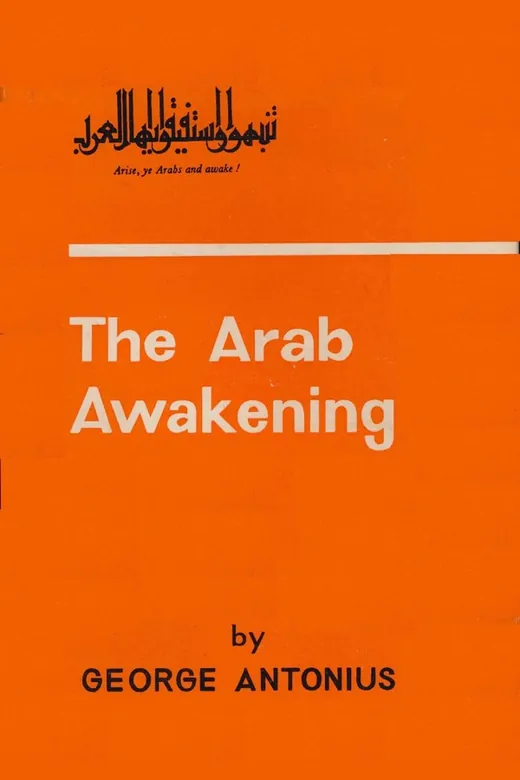
The cover of The Arab Awakening: The Story of the Arab National Movement

The Arab Awakening: The Story of the Arab National Movement

How did the Arab national movement begin, grow and meet its main problems, told from Arab and European sources together?

At a glance

Author
George Antonius

Why read it

  • You will see how a national movement grows from schools, societies and ideas before it becomes politics
  • You will get the Arab side of a story that most Western histories tell only from European sources
  • You will learn how wartime declarations and the mandate system set the terms for Syria and Iraq

Who it is for

  • A reader trying to understand the roots of today's Middle East map
  • A student of nationalism and empire
  • A journalist covering Syria or Iraq who wants the long background

Contents

  1. FOREWORD
  2. CHAPTER 1—THE BACKGROUND
  3. 1. The background
  4. 2. Geographical setting
  5. 3. Arabisation and Islamisation
  6. 4. The Arab world defined
  7. 5. The Turkish conquest
  8. CHAPTER II—A FALSE START
  9. 1. Mehemed-‘Ali in Egypt and the Wahhabi movement
  10. 2. His conquest of Syria
  11. 3. His plan for an Arab empire
  12. 4. Ibrahim Pasha in Syria
  13. 5. Palmerston’s opposition
  14. 6. National consciousness non-existent
  15. 7. The plan fails
  16. CHAPTER III—THE START: 1847-68
  17. 1. First missionaries in Syria
  18. 2. Educational beginnings
  19. 3. Egyptian system
  20. 4. American activities
  21. 5. Catholic activities
  22. 6. Nasif Yazeji
  23. 7. Butrus Bustani
  24. 8. The first literary societies
  25. 9. The earliest patriotic ode
  26. 10. Historical retrospect
  27. CHAPTER IV—THE HAMIDIAN DESPOTISM: 1876—1908
  28. 1. Deposition of ‘Abdul-‘Aziz
  29. 2. The Constitution of 1876
  30. 3. The Sultan’s Arab possessions
  31. 4. Foundations of ‘Abdul-Hamid’s rule
  32. 5. His Islamic policy
  33. 6. The Hejaz Railway
  34. 7. The growth of German influence
  35. CHAPTER V—THE INFANT MOVEMENT: 1868-1908
  36. 1. The Beirut secret society
  37. 2. Its proclamations
  38. 3. Its effect on the movement of ideas
  39. 4. Its programme
  40. 5. Its place in the history of the movement
  41. 6. Repercussions
  42. 7. The influence of Western education
  43. 8. Moslem leadership
  44. 9. ‘Abdul-Rahman al-Kawakebi
  45. 10. Najib ‘Azuri
  46. 11. Egyptian nationalism
  47. CHAPTER VI—YOUNG ARABS AND YOUNG TURKS: 1908-14
  48. 1. The Turco-Arab honeymoon
  49. 2. The Turco-Arab estrangement
  50. 3. Four Arab societies
  51. 4. The Committee of Reform
  52. 5. The First Arab Congress
  53. 6. The trial of ‘Aziz ‘Ali
  54. 7. The Sultan’s Arab empire
  55. CHAPTER VII—THE WAR AND THE HOLY WAR: 1914
  56. 1. The Amir ‘Abdullah and Lord Kitchener
  57. 2. Importance of Amir ‘Abdullah and Lord Kitchener’s meeting
  58. 3. Kitchener’s overtures
  59. 4. The threat of jihad
  60. 5. The military outlook in the Arab world

More books like this