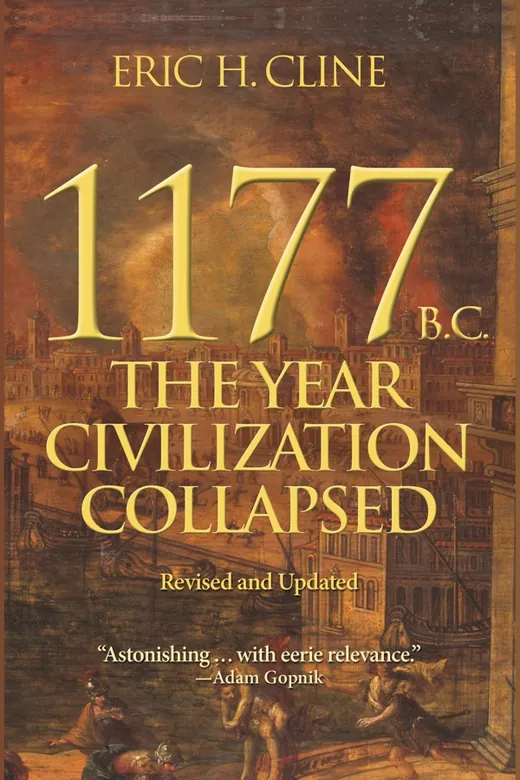
1177 B.C.
Follow the evidence behind the Late Bronze Age collapse, from royal diplomacy to drought and migration, and see why 1177 BC marks a prolonged, uneven breakdown.
8 parts, about 27 minutes to read.


Follow the evidence behind the Late Bronze Age collapse, from royal diplomacy to drought and migration, and see why 1177 BC marks a prolonged, uneven breakdown.
8 parts, about 27 minutes to read.
The book's most contested claim is that the end of the Late Bronze Age is best understood as a systems collapse rather than a conquest with one clear cause. Cline reviews invasions associated with the Sea Peoples, earthquakes, drought, famine, rebellions, disrupted trade, and political weakness, then argues that their interaction matters more than any item alone. A common objection is that a broad systems explanation can become difficult to disprove because almost every crisis can be added to the model. Cline responds by distinguishing evidence that is secure from explanations that remain possible and by tracing how tightly connected palaces depended on trade and one another. He does not claim that every kingdom fell at the same moment or for the same local reason. The argument is strongest as an account of compounding vulnerability and weakest when readers treat it as a precise formula that identifies the decisive weight of each cause.
 1929Andrew Ross Sorkin
 A History of WarfareJohn Keegan
 A River Running West: The Life of John Wesley PowellDonald Worster
 A secret history of the IRAEd Moloney
 AfghanistanThomas Barfield
 Alive: The Story of the Andes SurvivorsPiers Paul Read
 All the Shah's Men: An American Coup and the Roots of Middle East TerrorStephen Kinzer
 American SphinxJoseph J. Ellis
 An Unfinished Life: John F. Kennedy 1917-1963Robert Dallek
 At the Center of the Storm: My Years at the CIAGeorge Tenet, Bill Harlow
 Beyond the Hundredth MeridianWallace Stegner
 Black Reconstruction in America, 1860–1880W. E. B. Du Bois