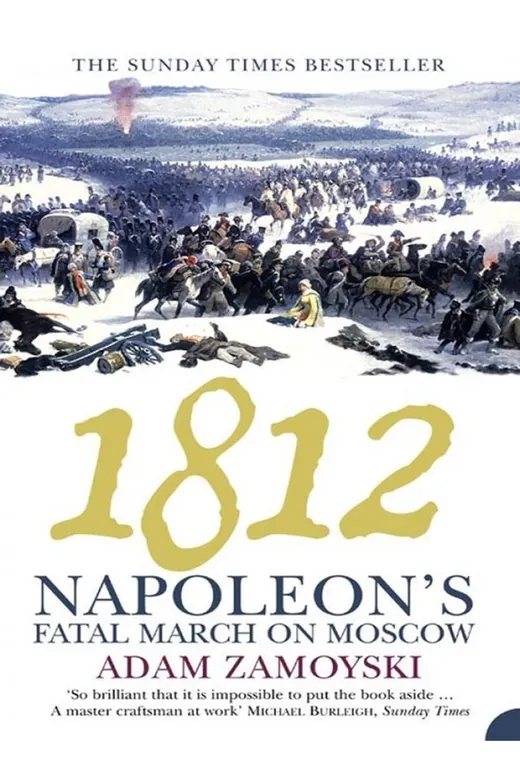
1812: Napoleon’s Fatal March on Moscow
Why did Napoleon's invasion of Russia end in disaster, and why do so many people know so little of what really happened?
 Knowingo
Why did Napoleon's invasion of Russia end in disaster, and why do so many people know so little of what really happened?
The most useful dispute around Zamoyski's account concerns the familiar claim that the Russian winter defeated Napoleon. The narrative instead makes the catastrophe cumulative: political miscalculation, immense distance, poor supply, disease, heat, desertion, combat, Russian withdrawal, Moscow's destruction, and command failures had already damaged the army before the deepest cold. A common objection is that correcting the winter legend can understate the lethal force of freezing weather during the retreat. Zamoyski does not remove weather from the explanation, since cold, ice, hunger, and exposure dominate crucial stages of the withdrawal. He places them in a sequence rather than treating them as an independent surprise that destroyed an otherwise intact force. The result shifts responsibility back toward human decisions while preserving the environment as an accelerator of losses that logistics, exhaustion, and the failure to secure a political settlement had made harder to survive.
 1177 B.C.Eric H. Cline
 1929Andrew Ross Sorkin
 A History of the Arab PeoplesAlbert Hourani
 A History of WarfareJohn Keegan
 A Midwife's Tale: The Life of Martha Ballard, Based on Her Diary, 1785–1812Laurel Thatcher Ulrich
 A Patriot's History of the United States: From Columbus's Great Discovery to the War on TerrorLarry Schweikart, Michael Patrick Allen
 A People's Tragedy: The Russian Revolution 1891–1924Orlando Figes
 A Problem From Hell: America and the Age of GenocideSamantha Power
 A River Running West: The Life of John Wesley PowellDonald Worster
 A Rumor of WarPhilip Caputo
 A Savage War of Peace: Algeria 1954–1962Alistair Horne
 A secret history of the IRAEd Moloney