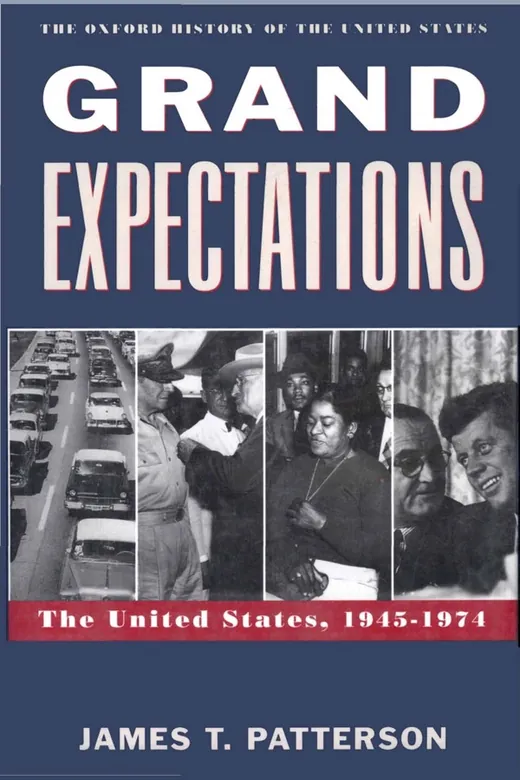
The cover of Grand Expectations: The United States, 1945–1974

Grand Expectations: The United States, 1945–1974

How did Americans come to expect that their country could improve the world and build a fairer society at home, and what became of that hope?

At a glance

Author
James T. Patterson

Why read it

  • You will see how confidence in the economy and government fed a rights revolution
  • You will understand how Americans came to believe they could shape the world in their own image
  • You will learn how a period of real economic and civic progress still ended in rancor

Who it is for

  • A reader who wants one clear account of postwar America
  • Someone puzzled by how the fifties led to the sixties
  • A voter curious where American confidence and anger come from

Contents

  1. Preface
  2. Europe, 1946–1989
  3. The Korean War, 1950–1953
  4. Conflict in Cuba, 1961–1962
  5. The Vietnam War
  6. Editor's Introduction
  7. Churchill, Truman, and Stalin at the Potsdam Conference, Germany, July 1945.
  8. Bess and Harry Truman, House Democratic Leader Sam Rayburn of Texas, and Margaret Truman at a party dinner, Washington, April 1947.
  9. James F. Byrnes, Truman, and Commerce Secretary Henry Wallace await FDR's funeral train at Washington's Union Station, April 1945. By 1946 Byrnes, then Secretary of State, and Wallace held sharply opposing views concerning foreign policy.
  10. General George Marshall and Secretary of State Dean Acheson, at a meeting to celebrate progress under the Marshall Plan, April 1950.
  11. Robert Taft (l.) and Thomas Dewey, opposing G.O.P. leaders in the 1940s, put on a cooperative pose in July 1948, during Dewey's campaign for the presidency.
  12. Truman awards the Distinguished Service Medal to General Douglas MacArthur, Wake Island, October 1950.
  13. General MacArthur (r.) confers with General Matthew Ridgway (2d. from left), near the front lines in Korea, January 1951. General Courtney Whitney, a top aide to MacArthur, is at left.
  14. General Eisenhower, then NATO commander, hearing the news of MacArthur's dismissal, April 1951.
  15. U.S. Marines cover a just-flushed North Korean soldier, August 1950.
  16. Jackie Robinson, who broke the color line in Major League baseball, in 1947.
  17. Evangelist Billy Graham.
  18. Elvis Presley, 1957.
  19. Marilyn Monroe, posing for photographers during filming of The Seven Year Itch (1955).
  20. The Consumer Culture: Automobiles. U.S. News, August 1952.
  21. The Consumer Culture: Electronics—the rise of the transistor. Look, July 1962.
  22. Senator Joe McCarthy, March 1954.
  23. Hunting for Reds in the 1950s.
  24. The Warren Court at the White House, November 1953.
  25. The Supreme Court under siege: Warren and protestors, October 1963.
  26. Ike and Secretary of State Dulles.
  27. The perils of Brinkmanship.
  28. The "kitchen debate," 1959, Moscow.
  29. Presidential nominee Adlai Stevenson (r.) and his Democratic running mate, Estes Kefauver, in 1956.
  30. Richard and Pat Nixon, campaigning for the presidency, August 1960.
  31. Rosa Parks being fingerprinted, February 1956, during the Montgomery bus boycott.
  32. The desegregation of Montgomery buses: The Rev. Ralph Abernathy (front row, left), the Rev. Martin Luther King, Jr. (second row), and the Rev. Glenn Smiley, ride a bus in December 1956.
  33. The Greensboro sit-in, February 2, 1960.
  34. King and Hubert Humphrey at a banquet, May 1965.
  35. MaIcolm X, March 1964.
  36. "Black power" spokesman Stokely Carmichael, May, 1966.
  37. LBJ and JFK at the Democratic National Convention, July 1960.
  38. The Kennedy brothers and J. Edgar Hoover of the FBI.
  39. Bobby Kennedy and Cesar Chavez.
  40. Secretary of Defense Robert McNamara, General Maxwell Taylor, Kennedy, and Secretary of State Dean Rusk.
  41. Dean Rusk and Senator J. William Fulbright, January 1962.
  42. Left to right: National Security Adviser McGeorge Bundy, Ambassador Maxwell Taylor, and General William Westmoreland, in Vietnam, February 1965.
  43. Antiwar protestors, Washington, October 1967.
  44. Spec. 4 Ronald Abernathy of Evanston, Ill., on patrol in South Vietnam, March 1967.
  45. A wounded GI, in battle of Hue, 1968.
  46. LBJ, July 31, 1968.
  47. Betty Friedan, 1964.
  48. Protest for women's rights, 1970.
  49. Alabama Governor George Wallace, May 1964.
  50. Minnesota Senator Eugene McCarthy, July 1964.
  51. Henry Kissinger, Vice President Spiro Agnew, and President Richard Nixon, January 1970.
  52. Kissinger, crossing his fingers and holding a whip along with a shield of peace, September 1973.
  53. George McGovern (r.) with campaign adviser Larry O'Brien (l.) and Senator Thomas Eagleton of Missouri, McGovern's running mate, July 1972.
  54. Expectations disrupted.
  55. Prologue: August 1945 [3]
  56. 1 Veterans, Ethnics, Blacks, Women [10]
  57. 2 Unions, Liberals, and the State: Stalemate [39]
  58. 3 Booms [61]
  59. 4 Grand Expectations About the World [82]
  60. 5 Hardening of the Cold War, 1945–1948 [105]

More books like this