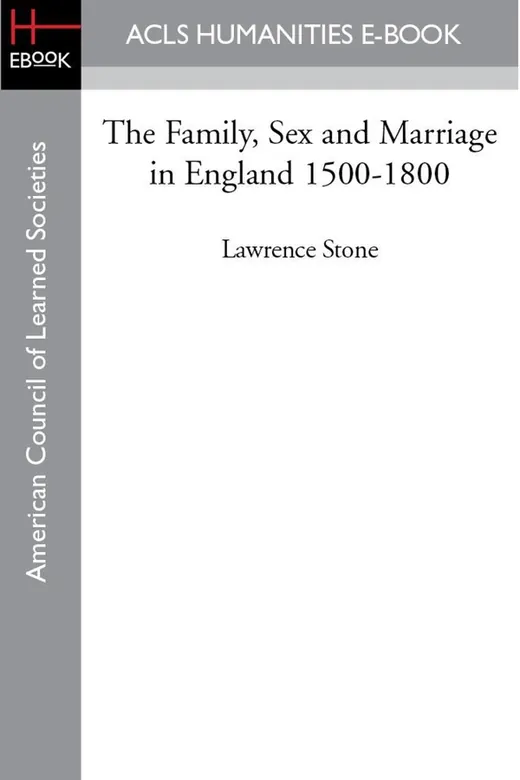
The cover of The Family, Sex and Marriage in England 1500–1800

The Family, Sex and Marriage in England 1500–1800

How did English family life change over three centuries, from loyalty to the house toward the pursuit of individual happiness?

At a glance

Author
Lawrence Stone

Why read it

  • You will see that marrying for affection and treating childhood as a long separate stage both have a history, not a timeless nature
  • You will learn to read social change as a tug of war between kin, church, state and the individual
  • You will understand how age at marriage and early death shaped family choices

Who it is for

  • A parent wondering where today's ideas of childhood came from
  • A newlywed curious why we marry for love
  • A genealogist trying to picture an ancestor's household

Contents

  1. Graphs
  2. PART ONE Introduction
  3. CHAPTER 1
  4. Problems, Methods and Definitions
  5. I THE PATTERN OF CHANGE
  6. i. The Problem
  7. ii. The Stages in Family Evolution
  8. iii. The Cultural Stratification of Family Types
  9. 2 EVIDENCE AND INTERPRETATION
  10. i. Sources
  11. ii. Problems of Interpretation
  12. iii. Historiography
  13. 3 METHODOLOGY
  14. i. The Approach
  15. ii. Six Points of View
  16. iii. Inadequate Methods
  17. iv. Linear or Cyclical Models
  18. 4 DEFINITION OF TERMS
  19. i. Family
  20. ii. Household
  21. iii. Lineage and Kin
  22. iv. Marriage
  23. v. Separation and Divorce
  24. CHAPTER 2
  25. The Demographic Facts
  26. I MARRIAGE
  27. i. Nuptiality
  28. ii. Age at First Marriage
  29. iii. Duration of Marriage
  30. iv. Horizons of Marriage
  31. 2 BIRTH
  32. 3 DEATH
  33. i. Mortality Rates
  34. ii. Examples
  35. iii. The Causes of Death
  36. 4 CONCLUSION
  37. PART TWO
  38. The Open Lineage Family 1450-1630
  39. CHAPTER 3
  40. Family Characteristics
  41. I STRUCTURE AND VALUES
  42. i. Nobility and Gentry
  43. ii. Plebs
  44. 2 AFFECTIVE RELATIONSHIPS
  45. i. The Society
  46. ii. Husbands and Wives
  47. iii. Parents and Children
  48. iv. Siblings
  49. 3 CONCLUSION
  50. PART THREE
  51. The Restricted Patriarchal Nuclear Family 1550-1700
  52. CHAPTER 4
  53. The Decline of Kinship, Clientage and Community
  54. I INTRODUCTION
  55. 2 THE LANDED CLASSES: THE DECLINE OF KINSHIP AND CLIENTAGE
  56. 3 THE MIDDLE RANKS: THE MODIFICATION OF KINSHIP
  57. 4 THE CAUSES OF CHANGE
  58. i. Political
  59. ii. Religious
  60. 5 PEASANTS, ARTISANS AND THE POOR: THE DECLINE OF COMMUNITY

More books like this