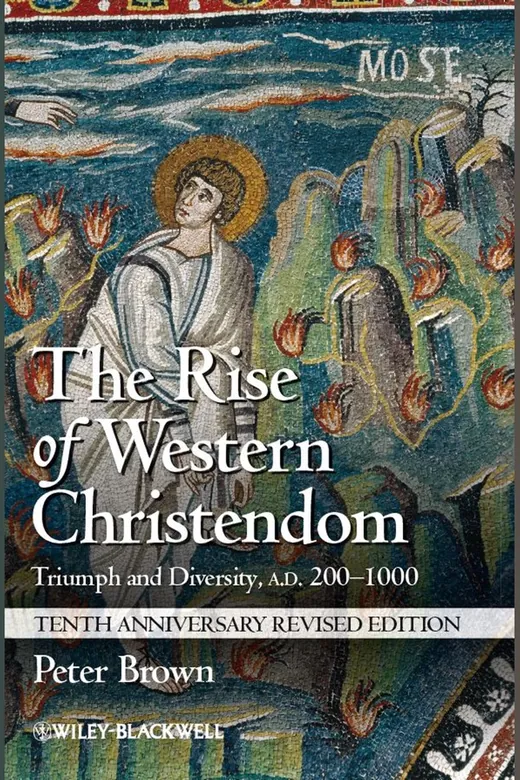
The cover of The Rise of Western Christendom

The Rise of Western Christendom

How did the end of Rome, the spread of Christianity and the arrival of Islam shape Europe, in centuries once dismissed as dark?

At a glance

Author
Peter Brown

Why read it

  • You will drop the idea that the centuries after Rome were simply a dark age
  • You will see Europe as one part of a wider world linked by trade, ideas and religion, not an isolated place
  • You will understand how a faith and a society changed together as an empire faded

Who it is for

  • A history reader who wants the story after Rome fell
  • A traveler visiting old churches and ruins in Europe
  • A student of religion in public life

Contents

  1. The Making of Europe
  2. Preface to the Tenth Anniversary Revised Edition
  3. A Wider Setting
  4. The View from Eurasia
  5. The Horizons of the Silk Road
  6. What is a Frontier?
  7. Christianity and Europe
  8. A New Frontier: the Christianities of the East
  9. A Common Market of Ideas
  10. The Entry of Islam
  11. From Asceticism to Holy War
  12. Civilization and the Fall of Rome
  13. The Drift from Rome
  14. Before and After Rome: States, Taxes, and Societies
  15. “Local Romanness” against “Central Romanness”: Regionalism and the End of Empire
  16. Soldier and Civilian in a Changing World
  17. From Civil War to Convulsion
  18. Loyalty: from Emperor to King
  19. From Civilian to Warrior
  20. Catastrophists
  21. Christianity: a History of Change
  22. Before the Cemetery
  23. Religion and the Household: the Creation of the Private
  24. The Second Church
  25. Christian Identity: Drawing the Frontier
  26. The Destruction of the Temples
  27. Barbarian Identity: Re-Fashioning the Past
  28. History and Christian Identity
  29. The Fate of the Secular
  30. Jews and Christians
  31. Silent Changes
  32. The Seventh Century: Change and Renewal
  33. A History of Heaven and Earth
  34. Preface to the Second Edition
  35. Introduction
  36. Western Europe in a Wider World
  37. The Making of Europe: “A History of European Unity”?
  38. Barbarians and Missionaries
  39. A Mediterranean Unity? The “Pirenne Thesis”
  40. After Empire: A World without a Center
  41. “Micro-Christendoms”: Center and Periphery in Christian Europe
  42. Early Medieval Christianity: A “Barbarized” Religion?
  43. “Background Noise”: Dark Age Christian Culture
  44. “Directly Ancestral”: The End of Ancient Christianity
  45. An Applied Christianity
  46. “Portions of Paradise”: Art, the Sacred, and Gift-Giving in Early Medieval Europe
  47. Part I
  48. Empire and Aftermath
  49. A.D. 200–500
  50. “The Laws of Countries”: Prologue and Overview
  51. One World, Two Empires
  52. Who are the Barbarians? Nomads and Farmers
  53. A Middle Ground: The Rise of the Frontier
  54. Christianity and Empire
  55. The New Empire: Crisis and Reform in the Roman Empire in the Third Century
  56. Religiones: The Ancient Religion
  57. New Religion in a New Empire: Christianity before Constantine
  58. “All malice will be wiped out”: Salvation, Martyrdom, and Penance in the Christian Church
  59. The Church and Society: Almsgiving
  60. From religiones to Religion

More books like this