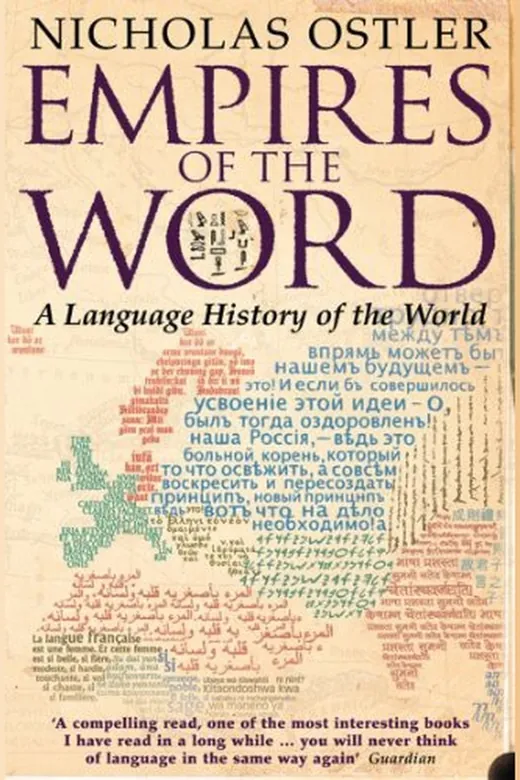
The cover of Empires of the Word: A Language History of the World

Empires of the Word: A Language History of the World

Why do some languages spread across the world while others vanish, when history is told through languages rather than kings and states?

At a glance

Author
Nicholas Ostler

Why read it

  • You will start to see languages, not only kings and armies, as the lasting players in history
  • You will see what lets a language spread, from political power to writing and the appeal of a culture
  • You will learn how a language carries a people's memories and stories forward

Who it is for

  • Language learners curious why they study the language they do
  • Readers of world history who want a fresh angle
  • People who speak two languages and wonder where each came from

Contents

  1. PREFACE
  2. PROLOGUE: A CLASH OF LANGUAGES
  3. PART I THE NATURE OF LANGUAGE HISTORY
  4. 1 Themistocles’ Carpet
  5. The language view of human history
  6. The state of nature
  7. Literacy and the beginning of language history
  8. An inward history too
  9. 2 What It Takes to Be a World Language; or, You Never Can Tell
  10. PART II LANGUAGES BY LAND
  11. 3 The Desert Blooms: Language Innovation in the Middle East
  12. Three sisters who span the history of 4500 years
  13. The story in brief: Language leapfrog
  14. Sumerian—the first classical language: Life after death
  15. FIRST INTERLUDE: WHATEVER HAPPENED TO ELAMITE?
  16. Akkadian—world-beating technology: A model of literacy
  17. Phoenician—commerce without culture: Canaan, and points west
  18. Aramaic—the desert song: Interlingua of western Asia
  19. SECOND INTERLUDE: THE SHIELD OF FAITH
  20. Arabic—eloquence and equality: The triumph of ‘submission’
  21. THIRD INTERLUDE: TURKIC AND PERSIAN, OUTRIDERS OF ISLAM
  22. A Middle Eastern inheritance: The glamour of the desert nomad
  23. 4 Triumphs of Fertility: Egyptian and Chinese
  24. Careers in parallel
  25. Language along the Nile
  26. Language from Huang-he to Yangtze
  27. Whys and wherefores
  28. Holding fast to a system of writing
  29. Foreign relations
  30. Coping with invasions: Egyptian undercut
  31. Coping with invasions: Chinese unsettled
  32. 5 Charming Like a Creeper: The Cultured Career of Sanskrit
  33. The story in brief
  34. The character of Sanskrit
  35. The spread of Sanskrit
  36. The charm of Sanskrit
  37. Sanskrit no longer alone
  38. 6 Three Thousand Years of Solipsism: The Adventures of Greek
  39. Greek at its acme
  40. Who is a Greek?
  41. What kind of a language?
  42. Homes from home: Greek spread through settlement
  43. Kings of Asia: Greek spread through war
  44. A Roman welcome: Greek spread through culture
  45. Mid-life crisis: Attempt at a new beginning
  46. Intimations of decline
  47. Anatolia
  48. Consolations in age
  49. Retrospect: The life cycle of a classic
  50. 7 Contesting Europe: Celt, Roman, German and Slav
  51. Reversals of fortune
  52. The contenders: Greek and Roman views
  53. Rún: The impulsive pre-eminence of the Celts
  54. Consilium: The rationale of Roman Imperium
  55. Einfall: Germanic and Slavic advances
  56. 8 The First Death of Latin
  57. PART III: LANGUAGES BY SEA
  58. 9 The Second Death of Latin
  59. 10 Usurpers of Greatness: Spanish in the New World
  60. Portrait of a conquistador

More books like this