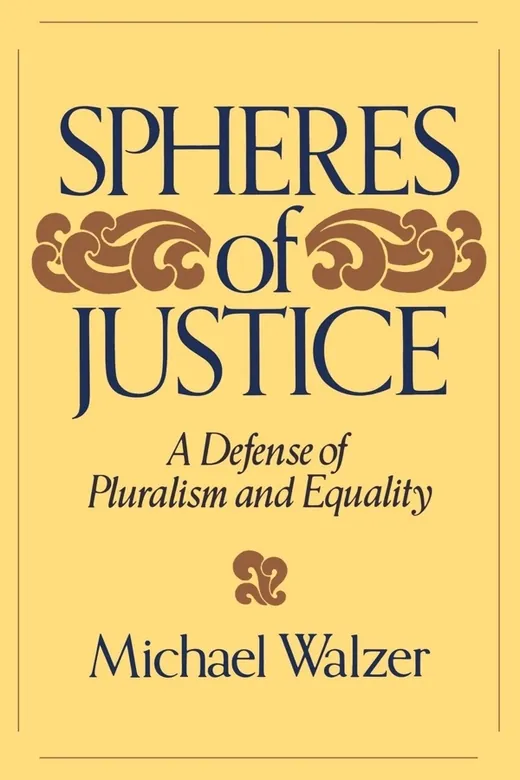
The cover of Spheres of Justice: A Defense of Pluralism and Equality

Spheres of Justice: A Defense of Pluralism and Equality

Is justice about everyone having the same amount of everything, or about keeping money, office and honor in their own separate spheres?

At a glance

Author
Michael Walzer

Why read it

  • You will see why giving everyone equal shares of everything cannot work, and what fairness can ask for instead
  • You will learn to judge a distribution by asking what kind of good it is, not only how much each person gets
  • You will spot when money or power is spilling into places where it does not belong

Who it is for

  • Managers deciding how to split pay, promotion and credit
  • Policy readers weighing fairness in welfare and markets
  • Anyone who feels money buys too much

Contents

  1. PREFACE
  2. 1 Complex Equality
  3. Pluralism
  4. A Theory of Goods
  5. Dominance and Monopoly
  6. Simple Equality
  7. Tyranny and Complex Equality
  8. Three Distributive Principles
  9. Hierarchies and Caste Societies
  10. The Setting of the Argument
  11. 2 Membership
  12. Members and Strangers
  13. Analogies: Neighborhoods, Clubs, and Families
  14. Territory
  15. Alienage and Naturalization
  16. Membership and Justice
  17. 3 Security and Welfare
  18. Membership and Need
  19. Communal Provision
  20. Fair Shares
  21. The Extent of Provision
  22. An American Welfare State
  23. A Note on Charity and Dependency
  24. 4 Money and Commodities
  25. The Universal Pander
  26. What Money Can’t Buy
  27. What Money Can Buy
  28. The Marketplace
  29. The Determination of Wages
  30. Redistributions
  31. Gifts and Inheritance
  32. 5 Office
  33. Simple Equality in the Sphere of Office
  34. Meritocracy
  35. The Meaning of Qualification
  36. The Reservation of Office
  37. Professionalism and the Insolence of Office
  38. The Containment of Office
  39. 6 Hard Work
  40. Equality and Hardness
  41. Dangerous Work
  42. Grueling Work
  43. Dirty Work
  44. 7 Free Time
  45. The Meaning of Leisure
  46. Two Forms of Rest
  47. 8 Education
  48. The Importance of Schools
  49. Basic Schooling: Autonomy and Equality
  50. Specialized Schools
  51. Association and Segregation
  52. 9 Kinship and Love
  53. The Distributions of Affect
  54. Family and Economy
  55. Marriage
  56. The Woman Question
  57. 10 Divine Grace
  58. The Wall between Church and State
  59. The Puritan Commonwealth
  60. 11 Recognition

More books like this