Knowingo
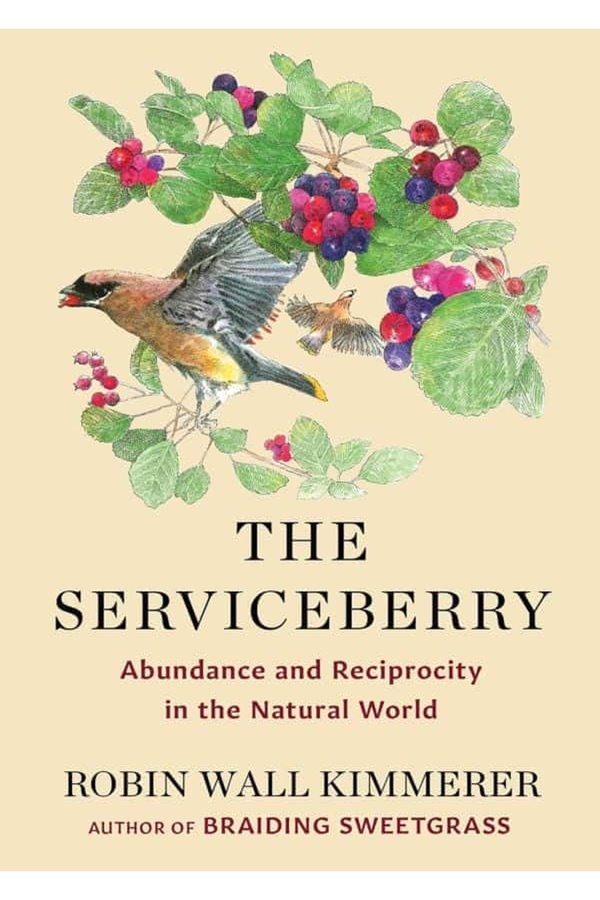
The cover of The Serviceberry

The Serviceberry

A botanist follows the serviceberry through a year to show how gift, gratitude and reciprocity can replace scarcity as the basis of a shared economy.

8 parts, about 16 minutes to read.

Why read it

  • See food, water and land as gifts rather than resources, and what that changes about how you take and give back
  • Compare gift and market economies, from Potawatomi giveaways that share surplus to the Honorable Harvest, which limits taking
  • Learn how a berry farm mixes selling and sharing, and why shared commons need trust, rules and restraint

Who it is for

  • Readers uneasy about consumption who want alternatives to market thinking
  • Local food buyers and small farmers weighing money against community
  • Readers interested in Indigenous knowledge of plants and reciprocity

What the summary covers

  1. A Bucket Full of Gifts2 min
  2. Keep the Gift in Motion2 min
  3. A Gift Makes Us Accountable1 min
  4. Wealth Stored in Relationship3 min
  5. Commons Need Trust and Restraint2 min
  6. What the Serviceberry Knows2 min
  7. Berries Beside the Market2 min
  8. Changing the Economic Landscape2 min

Recommended by

  • Anthony DoerrPulitzer Prize winning novelist
    The time you’ll spend reading this book will, like the time spent picking wild berries, nourish your soul, heart, and mind. I hope to give this book to everybody
  • James RebanksEnglish sheep farmer and author
    The Serviceberry is a gem of a book. It invites us to think again about economics, and imagine another way of relating to one another based on generosity, kindness, interconnectedness, and restraint.
About the author

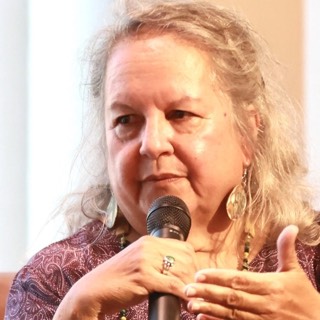
  • Robin Wall KimmererPotawatomi botanist, author and MacArthur Fellow
    • Trained as a botanist, she earned a bachelor's degree in 1975 from the State University of New York College of Environmental Science and Forestry, and a master's degree in 1979 and a PhD in 1983 from the University of Wisconsin.
    • She was born in 1953 in upstate New York and raised in the hamlet of Ballston Lake.
    • Her scientific expertise is the ecology of mosses and the restoration of ecological communities.
    • She is an enrolled member of the Citizen Potawatomi Nation and cofounded the Traditional Ecological Knowledge section of the Ecological Society of America.
    • She is a SUNY Distinguished Teaching Professor of Environmental Biology and founder and director of the Center for Native Peoples and the Environment, which builds programs that draw on both Indigenous and scientific knowledge for sustainability.
    • Her first book, Gathering Moss, won the John Burroughs Medal for outstanding nature writing.
    • Her book Braiding Sweetgrass received the 2014 Sigurd F. Olson Nature Writing Award.
    • She was named a MacArthur Fellow in 2022 for articulating an alternative vision of environmental stewardship informed by traditional ecological knowledge.

Read it alongside

More books like this