Knowingo
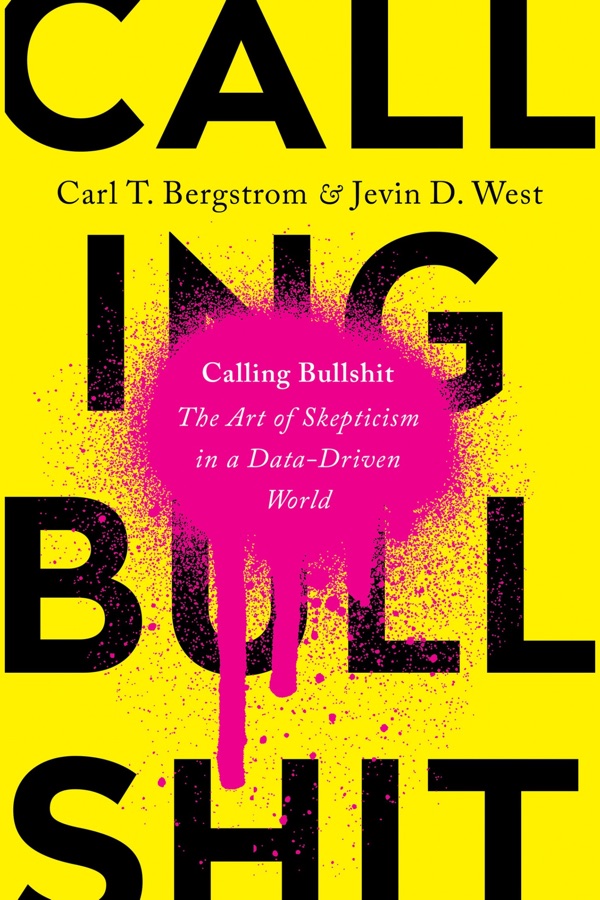
The cover of Calling Bullshit

Calling Bullshit

A practical guide to exposing misleading data, weak causal claims, and persuasive statistics while preserving confidence in sound scientific correction.

11 parts, about 29 minutes to read.

Why read it

  • Builds a practical method for testing persuasive numbers, causal stories, graphs and machine learning claims
  • Explains how selection, incentives and publication bias can distort evidence without making science useless
  • Shows how to refute misinformation clearly, proportionately and without turning correction into personal attack

Who it is for

  • Readers who want stronger defenses against misleading statistics
  • Journalists, educators, researchers and policy makers evaluating evidence
  • Anyone making decisions from charts, studies, rankings or algorithms

What the summary covers

  1. Preface2 min
  2. Medium, Message, and Misinformation2 min
  3. The Nature of Bullshit2 min
  4. Causality2 min
  5. Numbers and Nonsense3 min
  6. Selection Bias3 min
  7. Data Visualization2 min
  8. Calling Bullshit on Big Data3 min
  9. The Susceptibility of Science4 min
  10. Spotting Bullshit3 min
  11. Refuting Bullshit3 min

Recommended by

  • Cathy O'NeilMathematician, data scientist and author of Weapons of Math Destruction
    If I could make this critical handbook's contents required curriculum for every high school student (thus replacing trigonometry), then I would do so. I highly recommend Calling Bullshit for our modern existence in the age of misinformation

  • Jordan EllenbergProfessor of mathematics and author of How Not to Be Wrong
    The information landscape is strewn with quantitative cowflop; read this book if you want to know where not to step

About the authors

  • Carl T. BergstromUniversity of Washington biology professor studying information in biological and social systems
    • A theoretical and evolutionary biologist and professor at the University of Washington in Seattle.
    • Trained in evolutionary biology and mathematical population genetics, he works across the natural and social sciences.
    • His work uses evolutionary theory, mathematical game theory and signal transmission to study how information flows in the natural world.
    • He studies scientific institutions, scholarly communication and the spread of disinformation on social networks.
    • He and Jevin West launched Calling Bullshit to teach quantitative reasoning and information literacy.
  • Jevin D. WestUniversity of Washington professor studying data, technology and misinformation
    • Professor and Associate Dean for Research in the University of Washington Information School.
    • He was the inaugural director of the Center for an Informed Public and cofounded the DataLab.
    • He grew up in Ammon, Idaho and studied biology at Utah State University while playing tennis and skiing.
    • He began his doctorate at the University of Washington in 2005 with Carl Bergstrom and Ben Kerr, studying information processing in the evolution of life.
    • His research and teaching examine how data and technology affect science and society, especially the spread of misinformation.

More books like this