Knowingo
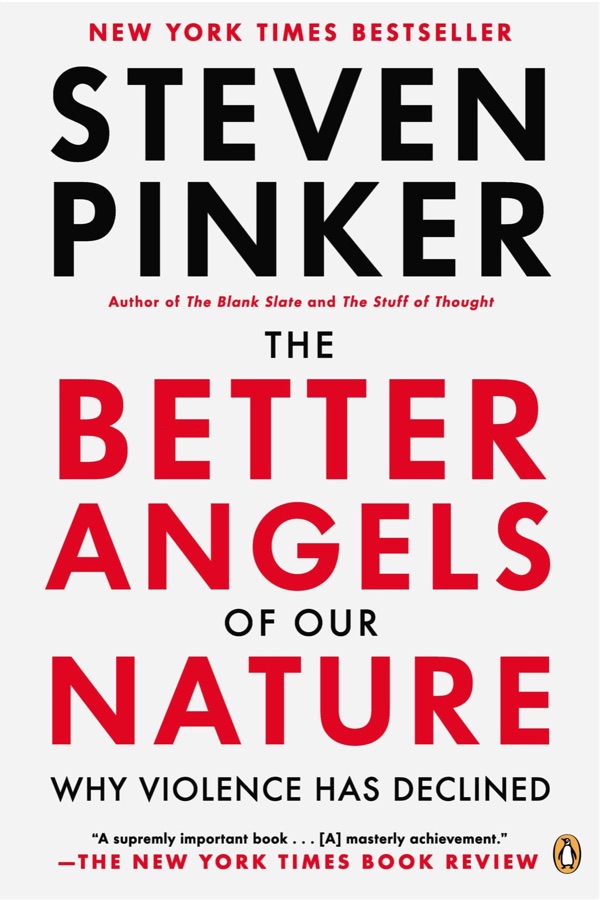
The cover of The Better Angels of Our Nature

The Better Angels of Our Nature

Data on war, homicide, torture and genocide show that violence has fallen over millennia, driven by states, commerce, empathy, restraint and reason acting on an unchanged human nature.

11 parts, about 39 minutes to read.

Why read it

  • Argues that violence of nearly every kind has fallen across history, from tribal raids and torture to war and child beating
  • Helps you look past vivid headlines and ask why there is peace, and which conditions keep it in place
  • Combines long runs of historical data with psychology, naming inner demons and better angels without promising progress will last

Who it is for

  • Readers convinced the world keeps getting more dangerous
  • Students of history, psychology or international relations
  • People who work to prevent war, crime or abuse

What the summary covers

  1. The Decline of Violence3 min
  2. A Foreign Country2 min
  3. The Pacification Process3 min
  4. The Civilizing Process4 min
  5. The Humanitarian Revolution4 min
  6. The Long Peace4 min
  7. The New Peace3 min
  8. The Rights Revolutions4 min
  9. Inner Demons4 min
  10. Better Angels5 min
  11. On Angels' Wings3 min

Recommended by

  • Bill GatesCofounder of Microsoft and chair of the Gates Foundation

About the author

  • Steven PinkerHarvard psychology professor and cognitive psychologist
    • Born in Montreal, Quebec, on 18 September 1954.
    • Bachelor's degree in psychology from McGill in 1976, then a PhD in experimental psychology at Harvard in 1979 under Stephen Kosslyn.
    • Taught at MIT's Department of Brain and Cognitive Sciences from 1982 to 2003.
    • Johnstone Family Professor of Psychology at Harvard since 2003.
    • His research covers language acquisition, emotion, the moral sense, rationality and trends in violence, the last being the subject of this book.
    • Named one of Time's 100 most influential people in the world in 2004.
    • Chaired the Usage Panel of the American Heritage Dictionary from 2008 to 2018.

Read it alongside

More books like this