Knowingo
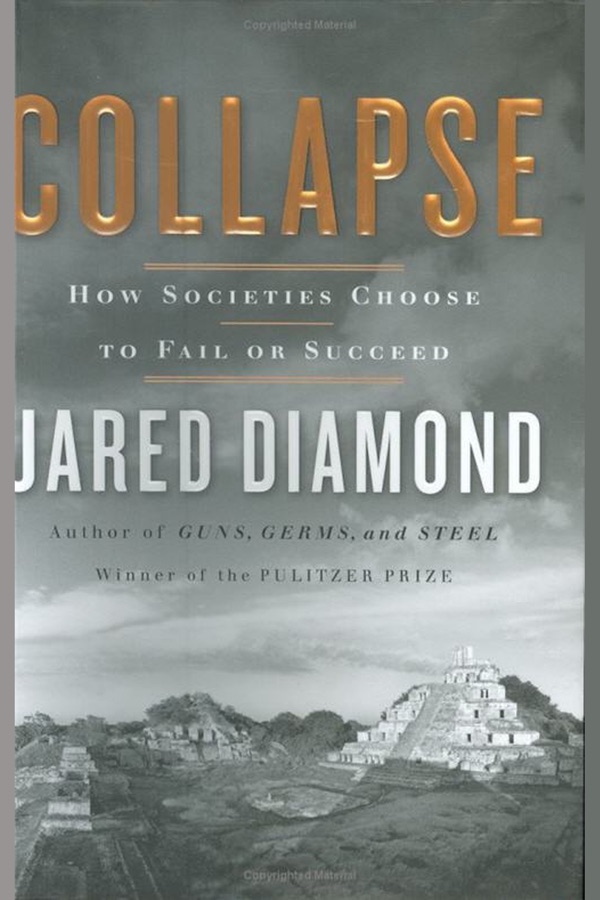
The cover of Collapse: How Societies Choose to Fail or Succeed

Collapse: How Societies Choose to Fail or Succeed

From Easter Island and Norse Greenland to Rwanda, China and Australia, Jared Diamond compares societies that wrecked their environments with those that solved their problems, and asks why.

17 parts, about 40 minutes to read.

Why read it

  • Lays out five factors behind collapse: environmental damage, climate change, hostile neighbors, loss of friendly trade partners, and how a society responds to its problems
  • Compares societies that collapsed, such as Easter Island, the Maya and Norse Greenland, with ones that coped, such as Tikopia and Tokugawa Japan
  • Explains why groups make disastrous decisions, from failing to anticipate or perceive a problem to rational bad behavior and clinging to old values

Who it is for

  • Readers worried about environmental damage and climate change
  • History readers curious why past civilizations vanished
  • Readers interested in how societies and businesses make decisions

What the summary covers

  1. A Tale of Two Farms3 min
  2. Under Montana's Big Sky2 min
  3. Twilight at Easter3 min
  4. Pitcairn and Henderson2 min
  5. The Anasazi2 min
  6. The Maya Collapses2 min
  7. The Viking Prelude and Fugues2 min
  8. Norse Greenland's Flowering2 min
  9. Norse Greenland's End2 min
  10. Opposite Paths to Success3 min
  11. Malthus in Africa: Rwanda's Genocide2 min
  12. One Island, Two Peoples: the Dominican Republic and Haiti2 min
  13. China, Lurching Giant1 min
  14. "Mining" Australia3 min
  15. Why Societies Make Disastrous Decisions3 min
  16. Big Businesses and the Environment3 min
  17. The World as a Polder3 min

Recommended by

  • Bill GatesMicrosoft founder and philanthropist
  • Gregg EasterbrookReviewer for The New York Times Book Review

About the author

  • Jared DiamondMacArthur Fellow; UCLA professor of geography until 2024
    • Born 10 September 1937 in Boston, Massachusetts
    • Professor of physiology at UCLA Medical School from 1968, with a parallel career in ornithology and ecology in New Guinea from 1964
    • Second career in ornithology and ecology specialising in New Guinea, visiting from 1964

Read it alongside

More books like this