Knowingo
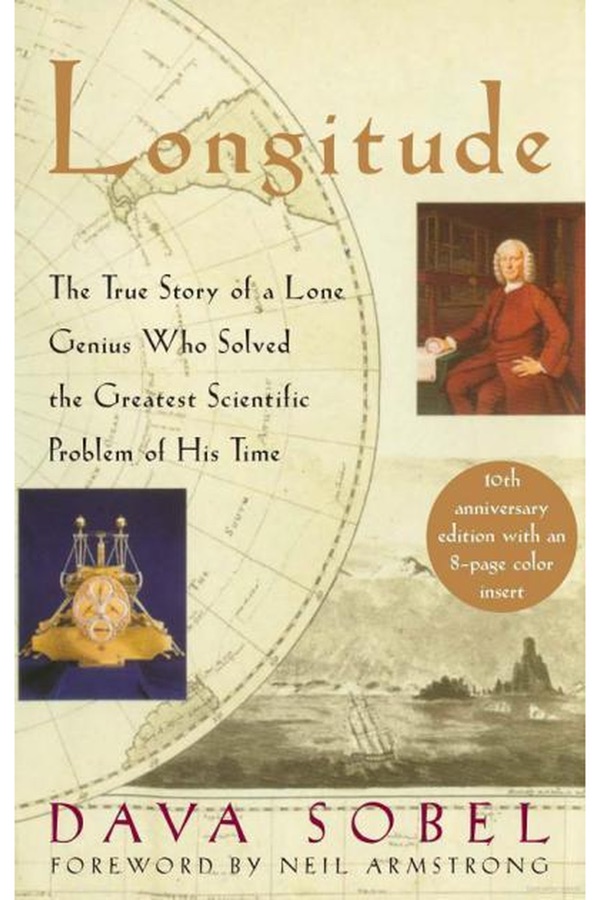
The cover of Longitude

Longitude

How John Harrison, an English clockmaker with no formal schooling, spent decades building sea clocks to win the 1714 longitude prize while astronomers backed the lunar distance method.

15 parts, about 25 minutes to read.

Why read it

  • Explains plainly why finding longitude at sea was so hard, and why an accurate clock turned out to be the answer
  • Follows a self taught village clockmaker through decades of invention against a board of astronomers backing the moon method
  • A compact case of how institutions, rivalry and shifting prize rules can hold back a working invention for years

Who it is for

  • Readers who love stories of lone inventors
  • Engineers and makers who enjoy mechanical ingenuity
  • Funders and judges who design prizes for new technology

What the summary covers

  1. Imaginary Lines2 min
  2. The Sea Before Time2 min
  3. Adrift in a Clockwork Universe2 min
  4. Time in a Bottle1 min
  5. Powder of Sympathy1 min
  6. The Prize1 min
  7. Cogmaker's Journal2 min
  8. The Grasshopper Goes to Sea2 min
  9. Hands on Heaven's Clock2 min
  10. The Diamond Timekeeper1 min
  11. Trial by Fire and Water2 min
  12. A Tale of Two Portraits2 min
  13. The Second Voyage of Captain James Cook2 min
  14. The Mass Production of Genius2 min
  15. In the Meridian Courtyard1 min

Recommended by

  • Diane AckermanAuthor of A Natural History of the Senses
    Longitude is a wonderful story, wonderfully told.

  • Patrick O'BrianAuthor of The Commodore and the Aubrey/Maturin series

About the author

  • Dava SobelAmerican writer of popular expositions of scientific topics
    • Born and raised in New York City, she grew up near the Bronx Zoo and attended the Bronx High School of Science, class of 1964.
    • She spent two years as a staff reporter in the Science News department of The New York Times.
    • She worked as a freelance magazine writer until Longitude appeared in 1995; its unexpected success let her take on books that need years of research.
    • As public relations liaison for Carl Sagan's Cosmos television series, she spent a month on site with the crew in Italy and Greece.
    • She holds honorary doctor of letters degrees from the University of Bath and Middlebury College, both awarded in 2002.
    • Her next book, Galileo's Daughter, was a finalist for the 2000 Pulitzer Prize for Biography or Autobiography.
    • In 2004 the Worshipful Company of Clockmakers in London gave her its Harrison Medal for raising public awareness of horology.
    • She was the only non scientist on the International Astronomical Union's Planet Definition Committee.

More books like this