Knowingo
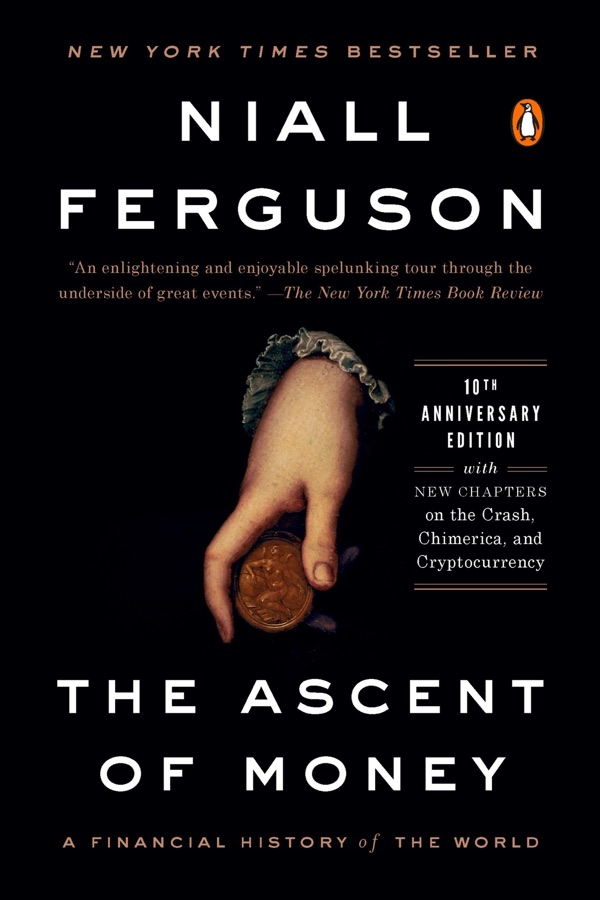
The cover of The Ascent of Money

The Ascent of Money

Niall Ferguson follows money from Mesopotamian clay tablets to Bitcoin, showing how banks, bonds, stock markets, insurance and home loans drove human progress, and why financial crises keep coming back.

11 parts, about 29 minutes to read.
Why read it

  • Traces how credit, bonds, stocks, insurance and housing finance grew, arguing that progress has depended on money and banks
  • Helps you see booms and busts as magnified human emotion, and ask which borrowers would break if interest rates rose
  • A historian ties ancient debts to the recent crash and the euro crisis, and admits where his own forecasts went wrong

Who it is for

  • Investors who want the long history behind today's markets
  • Readers still puzzled by the global financial crisis
  • Students of economics who find finance too abstract

What the summary covers

  1. Preface to the Second Edition2 min
  2. Introduction2 min
  3. Dreams of Avarice3 min
  4. Of Human Bondage3 min
  5. Blowing Bubbles3 min
  6. The Return of Risk3 min
  7. Safe as Houses3 min
  8. From Empire to Chimerica3 min
  9. The Descent of Money2 min
  10. The Slight Depression2 min
  11. From Euro to Ethereum3 min

Recommended by

  • Fareed ZakariaWriter for Newsweek
    Fascinating.
  • Kenneth RogoffProfessor of Economics, Harvard University
  • Susan Jane GilmanAuthor and memoirist
  • James McCuskerBothell economist, educator and consultant

About the author

  • Niall FergusonBritish and American historian, senior fellow at the Hoover Institution
    • Born in Glasgow in 1964; his father was a doctor and his mother a physics teacher.
    • Graduated from Oxford with a first in history in 1985.
    • Received his Oxford doctorate in 1989.
    • Spent a year as a Houblon Norman Fellow at the Bank of England, then published The Cash Nexus on money and power in 2001.
    • Wrote the history of the Rothschild banking family, The World's Banker, published in 1998.
    • Became professor of financial history at New York University in 2002 and professor of history at Harvard in 2004.
    • Named one of Time magazine's 100 most influential people in the world in 2004.
    • Left Harvard in 2016 to become a senior fellow at the Hoover Institution.

More books like this