
Knowingo
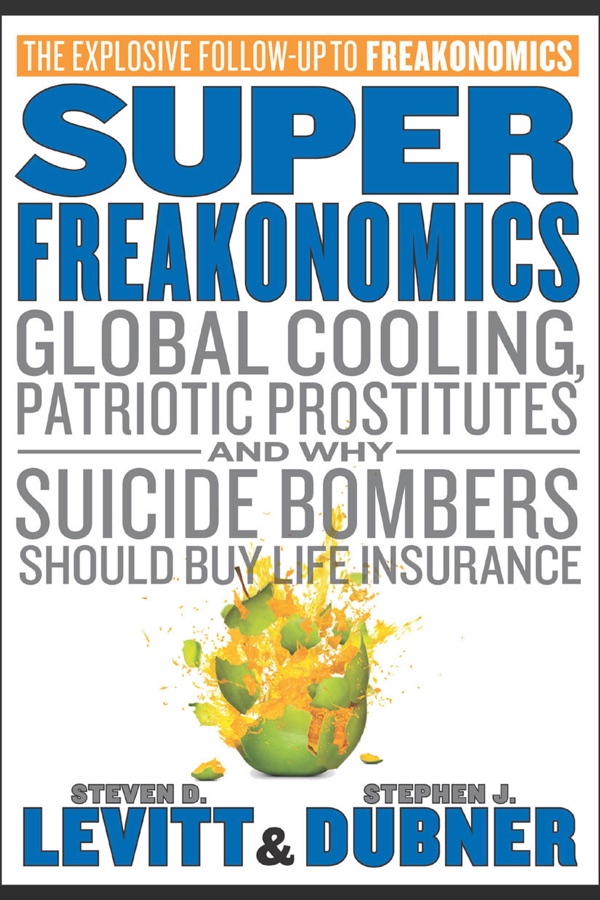
The cover of SuperFreakonomics

SuperFreakonomics

Levitt and Dubner follow incentives and data into unexpected places, from street prostitution and terrorist hunting to hand washing and geoengineering, and defend cheap, simple fixes against costly ones.

14 parts, about 23 minutes to read.
Why read it

  • Follow the data behind surprising answers, like why drunk walking is deadlier per mile than drunk driving and why street prostitutes now earn far less
  • Watch famous stories unravel: lab generosity that shrinks when players can take money, and a Queens murder with half a dozen usable witnesses
  • Weigh cheap, simple fixes against costly ones: chlorinated hand washing, seat belts versus car seats from age two, and a stratospheric sulfur dioxide hose

Who it is for

  • Readers curious how economists use data on crime, sex work and terrorism
  • Parents weighing car seats against seat belts for children from age two
  • Climate policy readers weighing cheap geoengineering against asking people to change

What the summary covers

  1. Incentives and unintended consequences1 min
  2. Drunk walkers, cable TV and horses2 min
  3. What a street prostitute earns3 min
  4. Allie, her own madam1 min
  5. The leverage of terror1 min
  6. Fixing the emergency room1 min
  7. Hunting terrorists through bank data2 min
  8. The 38 witnesses of Kew Gardens1 min
  9. Generous in the lab, greedy on the floor2 min
  10. What really happened that night2 min
  11. Semmelweis and the doctors' hands1 min
  12. Seat belts and car seats2 min
  13. A garden hose to the stratosphere3 min
  14. Monkeys with money1 min

Recommended by

  • Tim HarfordFinancial Times columnist and author of The Undercover Economist
    Like Freakonomics, but better . . . thrilling . . . you are guaranteed a good time . . . underneath the dazzle, there is substance too
  • Tom StandageDeputy editor of The Economist
    Levitt is a master at drawing counter-intuitive conclusions . . . great fun . . . Superfreakonomics travels further than its predecessor
  • Bill GatesMicrosoft cofounder and philanthropist
    I recommend this book to anyone who reads nonfiction. It is very well written and full of great insights.

About the authors

  • Steven D. LevittUniversity of Chicago economist and coauthor of the Freakonomics books
    • Steven David Levitt was born on May 29, 1967.
    • He attended St. Paul Academy and Summit School in St. Paul, Minnesota.
    • He received his bachelor's degree from Harvard in 1989 and his PhD from MIT in 1994, both in economics.
    • He graduated from Harvard summa cum laude.
    • He won the Young prize for the best undergraduate thesis in economics.
    • He worked as a management consultant at Corporate Decisions, Inc. from 1989 to 1991.
    • He was a Junior Fellow of the Harvard Society of Fellows from 1994 to 1997.
    • He has taught at the University of Chicago since 1997.
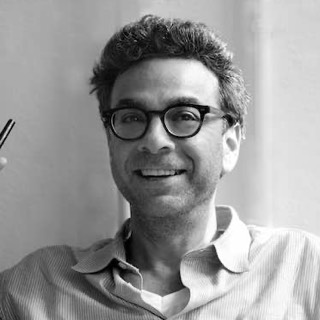
  • Stephen J. DubnerJournalist, radio host and coauthor of the Freakonomics books
    • He was the eighth and last child of an upstate New York newspaperman.
    • He grew up in a small town in rural upstate New York.
    • As an undergraduate at Appalachian State University he started a rock band that signed with Arista Records.
    • He quit music for an MFA in writing at Columbia University, where he also taught in the English Department.
    • He was an editor and writer at New York magazine and The New York Times before leaving to write books.
    • His first book was the memoir Turbulent Souls, published in 1998.
    • A New York Times Magazine assignment to profile the young economist Steven Levitt led to Freakonomics.
    • Besides the Freakonomics books he wrote Turbulent Souls, Confessions of a Hero Worshiper and the children's book The Boy With Two Belly Buttons.

More books like this