Knowingo
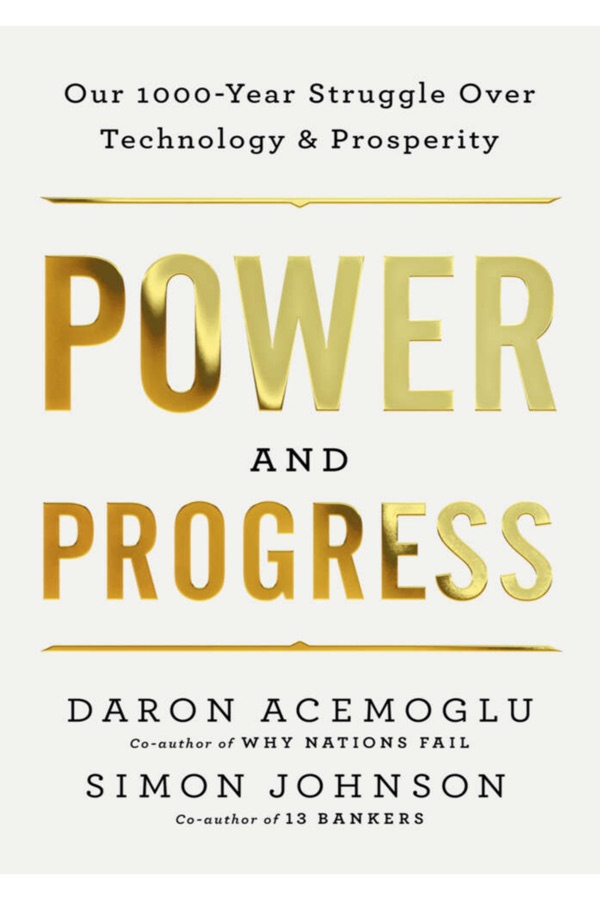
The cover of Power and Progress

Power and Progress

Explains why technology creates shared prosperity only when people shape its direction, build useful new tasks, and gain enough power to share the benefits.

9 parts, about 29 minutes to read.

Why read it

  • Shows why higher productivity does not automatically raise wages, using a millennium of evidence from medieval mills to artificial intelligence
  • Explains how new tasks, bargaining power, and democratic voice turn technology into shared prosperity while automation and surveillance concentrate its gains
  • Offers a practical agenda for redirecting digital technology through worker organization, tax reform, public research, privacy rules, data unions, and platform accountability

Who it is for

  • Readers asking why technological progress can coexist with stagnant wages and inequality
  • Workers and policy makers deciding whether automation should replace or empower people
  • Citizens concerned about artificial intelligence, surveillance, platform power, and democratic control

What the summary covers

  1. Progress and Control3 min
  2. Vision and Power3 min
  3. A Thousand Years of Unequal Gains2 min
  4. The Contested Industrial Path4 min
  5. A More Inclusive Technical Path2 min
  6. The Digital Reversal4 min
  7. Intelligence or Usefulness4 min
  8. Democracy Under Pressure3 min
  9. Redirecting Technology4 min

Recommended by

  • Jaron LanierAuthor and Microsoft technology researcher
    This singular book elevated my understanding of the present confluence of society, economics, and technology. Here we have a synthesis of history and analysis coupled with specific ideas about how the future can be improved. It pulls no punches but also inspires optimism.

  • Jared DiamondPulitzer Prize winning author and UCLA geographer
  • Michael J. SandelHarvard professor of government and political philosopher
  • Shoshana ZuboffHarvard Business School professor emerita and author
  • Ro KhannaUnited States representative for Silicon Valley
    The technology of artificial intelligence is moving fast and likely to accelerate. This powerful book shows we now need to make some careful choices to really share the benefits and reduce unintended, adverse consequences. Technology is too important to leave to the billionaires. Everyone everywhere should read Acemoglu and Johnson—and try to get a seat at the decision-making table.


About the authors

  • Daron AcemogluNobel laureate in economic sciences and MIT Institute Professor
    • An Institute Professor at MIT and faculty codirector of the Stone Center on Inequality and Shaping the Future of Work.
    • His research spans political economy, development, growth, technological change, inequality, labor economics and economic networks.
    • He was born on 3 September 1967 in Istanbul, Turkey.
    • He received the 2024 prize in economic sciences for research on how institutions form and affect prosperity.
  • Simon JohnsonNobel laureate in economic sciences and MIT professor of entrepreneurship
    • The Ronald A. Kurtz Professor of Entrepreneurship at MIT Sloan and head of its Global Economics and Management group.
    • He served as chief economist and director of the Research Department at the International Monetary Fund in 2007 and 2008.
    • He earned degrees from Oxford and Manchester before completing his doctorate at MIT.
    • He received the 2024 prize in economic sciences for research on how institutions form and affect prosperity.
    • His work on Power and Progress examines the history and economics of major technological transformations through recent artificial intelligence developments.

More books like this