Knowingo
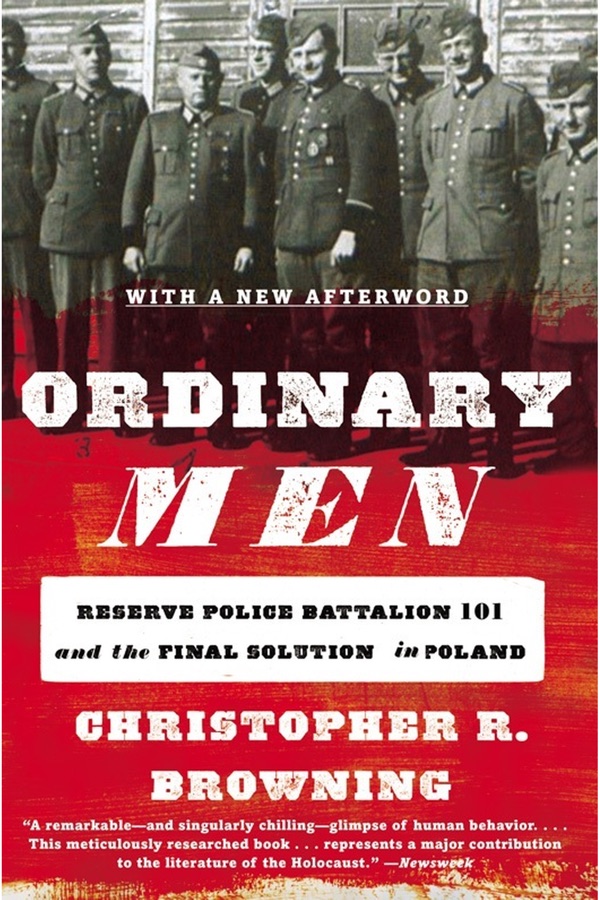
The cover of Ordinary Men

Ordinary Men

Drawing on the men's own postwar testimony, a historian shows how ordinary German reserve policemen, offered a chance to step out, became killers of tens of thousands of Polish Jews.

15 parts, about 24 minutes to read.

Why read it

  • Reconstructs one morning in a Polish village when middle aged policemen were offered a chance to step out of a massacre
  • Follows one reserve police battalion from its first massacre through deportations and the hunt for escaped Jews to the final mass shootings
  • Tests explanations such as obedience, careerism and indoctrination against postwar testimony, and finds that conformity to comrades weighed heavily

Who it is for

  • Readers of Holocaust history who want perpetrator testimony
  • Students of how groups pressure people into harm
  • Readers asking how ordinary people take part in atrocity

What the summary covers

  1. Preface1 min
  2. One Morning in Józefów1 min
  3. Reserve Police Battalion 1011 min
  4. Arrival in Poland1 min
  5. Initiation to Mass Murder: The Józefów Massacre4 min
  6. Reflections on a Massacre2 min
  7. Łomazy: The Descent of Second Company2 min
  8. The August Deportations to Treblinka1 min
  9. The "Jew Hunt"2 min
  10. The Last Massacres: "Harvest Festival"1 min
  11. Aftermath1 min
  12. Germans, Poles, and Jews1 min
  13. Ordinary Men3 min
  14. Afterword2 min
  15. Twenty five Years Later1 min

Recommended by

  • Norman NaimarkStanford historian
  • Steven KatzProfessor of Jewish Holocaust Studies, Boston University
  • Gwen AdsheadForensic psychiatrist and bestselling author
  • Lawrence KaplanForeign affairs commentator
  • Hester VaizeyFellow of Clare College, Cambridge, and author of Born in the GDR

About the author

  • Christopher R. BrowningAmerican historian and professor emeritus at the University of North Carolina at Chapel Hill
    • He earned a BA in history from Oberlin College in 1967 and an MA in history from the University of Wisconsin in Madison in 1968.
    • His 1975 doctoral thesis at the University of Wisconsin became his first book, on the German Foreign Office and the Final Solution, published in 1978.
    • He taught for 25 years at Pacific Lutheran University in Tacoma, Washington.
    • He held the Frank Porter Graham chair of history at the University of North Carolina at Chapel Hill until he retired in May 2014.
    • He served as an expert witness in two Holocaust denial cases, the second Zündel trial in Toronto in 1988 and David Irving's libel suit against Deborah Lipstadt in London in 2000.
    • He was elected a Fellow of the American Academy of Arts and Sciences in 2006.
    • The USC Shoah Foundation's research center credited Ordinary Men with influencing generations of scholars on what motivates mass murderers.
    • His book Remembering Survival, on a Nazi slave labor camp, won the 2011 Yad Vashem International Book Prize for Holocaust Research.

More books like this