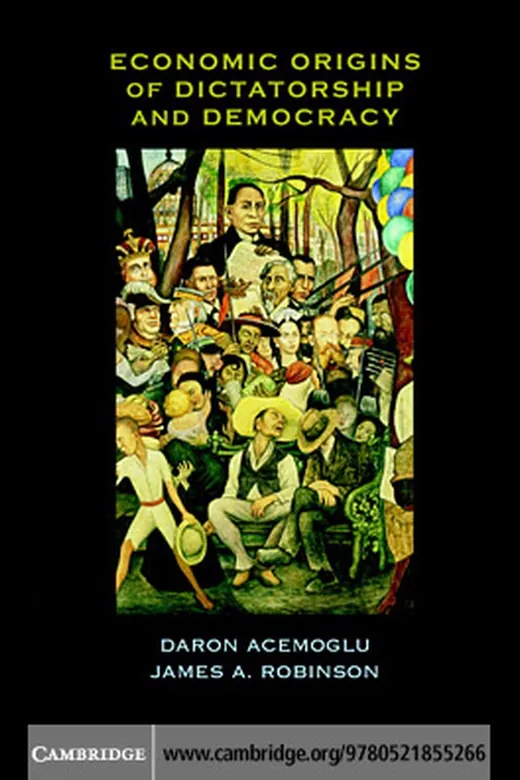
The cover of Economic origins of dictatorship and democracy

Economic origins of dictatorship and democracy

Why are some countries democracies, with free elections and accountable politicians, while others are not?

At a glance

Author
Daron Acemoglu, James A. Robinson

Why read it

  • You will see how political institutions can be understood as the outcome of conflict over who holds power
  • You will understand two separate questions: why societies become democratic, and why some democracies last while others collapse
  • You will learn why political commitment, whether those in power can be trusted to keep promises, sits at the heart of the theory

Who it is for

  • Political science student comparing paths to democracy
  • Reader wondering why some democracies slide back to dictatorship
  • Economist curious about politics and inequality

Contents

  1. ECONOMIC ORIGINS OF DICTATORSHIP AND DEMOCRACY
  2. Preface
  3. PART ONE. - QUESTIONS AND ANSWERS
  4. Chapter 1 - Paths of Political Development
  5. 1. Britain
  6. 2. Argentina
  7. 3. Singapore
  8. 4. South Africa
  9. 5. The Agenda
  10. Chapter 2 - Our Argument
  11. 1. Democracy versus Nondemocracy
  12. 2. Building Blocks of Our Approach
  13. 3. Toward Our Basic Story
  14. 4. Our Theory of Democratization
  15. 5. Democratic Consolidation
  16. 6. Determinants of Democracy
  17. 7. Political Identities and the Nature of Conflict
  18. 8. Democracy in a Picture
  19. 9. Overview of the Book
  20. Chapter 3 - What Do We Know about Democracy?
  21. 1. Measuring Democracy
  22. 2. Patterns of Democracy
  23. 3. Democracy, Inequality, and Redistribution
  24. 4. Crises and Democracy
  25. 5. Social Unrest and Democratization
  26. 6. The Literature
  27. 7. Our Contribution
  28. PART TWO. - MODELING POLITICS
  29. Chapter 4 - Democratic Politics
  30. 1. Introduction
  31. 2. Aggregating Individual Preferences
  32. 3. Single-Peaked Preferences and the Median Voter Theorem
  33. 4. Our Workhorse Models
  34. 5. Democracy and Political Equality
  35. 6. Conclusion
  36. Chapter 5 - Nondemocratic Politics
  37. 1. Introduction
  38. 2. Power and Constraints in Nondemocratic Politics
  39. 3. Modeling Preferences and Constraints in Nondemocracies
  40. 4. Commitment Problems
  41. 5. A Simple Game of Promises
  42. 6. A Dynamic Model
  43. 7. Incentive-Compatible Promises
  44. 8. Conclusion
  45. PART THREE. - THE CREATION AND CONSOLIDATION OF DEMOCRACY
  46. Chapter 6 - Democratization
  47. 1. Introduction
  48. 2. The Role of Political Institutions
  49. 3. Preferences over Political Institutions
  50. 4. Political Power and Institutions
  51. 5. A Static Model of Democratization
  52. 6. Democratization or Repression?
  53. 7. A Dynamic Model of Democratization
  54. 8. Subgame Perfect Equilibria
  55. 9. Alternative Political Identities
  56. 10. Targeted Transfers
  57. 11. Power of the Elites in Democracy
  58. 12. Ideological Preferences over Regimes
  59. 13. Democratization in a Picture
  60. 14. Equilibrium Revolutions

More books like this