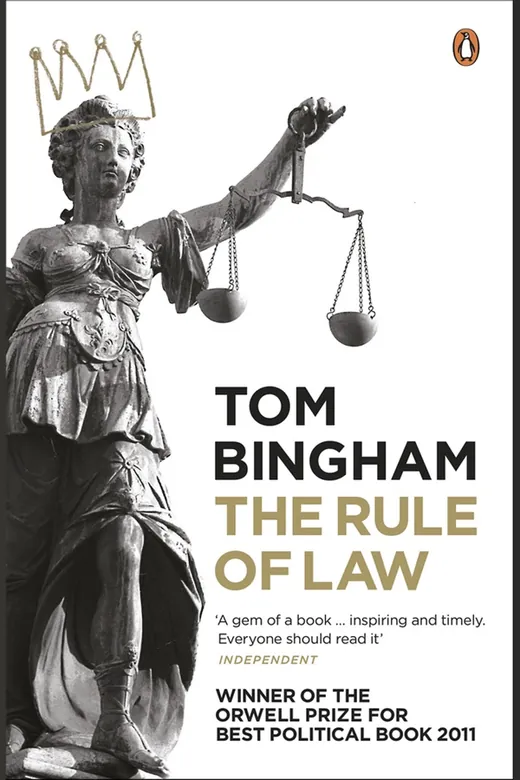
The cover of The Rule of Law

The Rule of Law

What does the rule of law actually mean, and what must a country have in place for the law to protect people from arbitrary power?

At a glance

Author
Tom Bingham

Why read it

  • You will be able to say clearly what the rule of law means when a politician uses the phrase
  • You will spot the warning signs of a state sliding into arbitrary rule, such as secret trials or detention without end
  • You will know which protections an ordinary person should expect from the law, from a fair trial to equal treatment

Who it is for

  • A voter judging government claims about security and liberty
  • A citizen who hears the phrase used without explanation
  • A student who wants a clear grounding in how legal freedoms arose

Contents

  1. Preface
  2. PART I
  3. The Importance of the Rule of Law
  4. Some History
  5. (1) Magna Carta 1215
  6. (2) Habeas corpus: the challenge to unlawful detention
  7. (3) The abolition of torture
  8. (4) The Petition of Right 1628
  9. (5) Sir Matthew Hale’s resolutions
  10. (6) The Habeas Corpus Amendment Act 1679
  11. (7) The Bill of Rights 1689 and the Act of Settlement 1701
  12. (8) The Constitution of the United States of America
  13. (9) The French Declaration of the Rights of Man and the Citizen 1789
  14. (10) The American Bill of Rights
  15. (11) The law of war
  16. (12) The Universal Declaration of Human Rights
  17. PART II
  18. The Accessibility of the Law
  19. (I) The law must be accessible and so far as possible intelligible, clear and predictable
  20. Statute law
  21. Judge-made law
  22. The law of the European Union
  23. Law not Discretion
  24. (2) Questions of legal right and liability should ordinarily be resolved by application of the law and not the exercise of discretion
  25. Equality Before the Law
  26. (3) The laws of the land should apply equally to all, save to the extent that objective differences justify differentiation
  27. The Exercise of Power
  28. (4) Ministers and public officers at all levels must exercise the powers conferred on them in good faith, fairly, for the purpose for which the powers were conferred, without exceeding the limits of such powers and not unreasonably
  29. Human Rights
  30. (5) The law must afford adequate protection of fundamental human rights
  31. Article 2: The right to life
  32. Article 3: The prohibition of torture
  33. Article 4: Prohibition of slavery and forced labour
  34. Article 5: Right to liberty and security
  35. Article 6: Right to a fair trial
  36. Article 7: No punishment without law
  37. Article 8: Right to respect for private and family life
  38. Article 9: Freedom of thought, conscience and religion
  39. Article 10: Freedom of expression
  40. Article 11: Freedom of assembly and association
  41. Article 12: Right to marry
  42. Article 14
  43. The First Protocol. Article 1. Protection of property
  44. The First Protocol. Article 2. Right to education
  45. Conclusion
  46. Dispute Resolution
  47. (6) Means must be provided for resolving, without prohibitive cost or inordinate delay, bona fide civil disputes which the parties themselves are unable to resolve
  48. A Fair Trial
  49. (7) Adjudicative procedures provided by the state should be fair
  50. Criminal trials
  51. Civil actions
  52. Hybrid procedures
  53. The Rule of Law in the International Legal Order
  54. (8) The rule of law requires compliance by the state with its obligations in international law as in national law
  55. War
  56. PART III
  57. Terrorism and the Rule of Law
  58. The war on terror
  59. Executive power
  60. Extraordinary rendition

More books like this