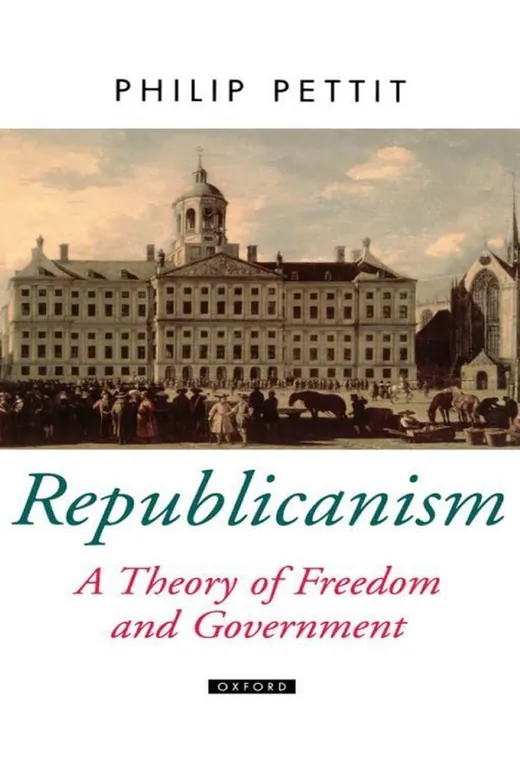
The cover of Republicanism: A Theory of Freedom and Government (Oxford Political Theory)

Republicanism: A Theory of Freedom and Government (Oxford Political Theory)

Is freedom more than being left alone, meaning not living under another's arbitrary power even if they never interfere?

At a glance

Author
Philip Pettit

Why read it

  • You will learn to tell apart a rule everyone can contest from arbitrary power that leaves you at someone's mercy
  • You will learn to tell being free from just happening to be left alone by those with power
  • You will see why humdrum institutions, such as committees, can matter crucially for protecting liberty

Who it is for

  • A citizen who feels powerless to challenge employers, landlords or officials
  • A politics student who finds freedom as being left alone too thin
  • Someone who designs rules or institutions and cares about fairness

Contents

  1. OXFORD POLITICAL THEORY
  2. OXFORD POLITICAL THEORY
  3. PREFACE
  4. INTRODUCTION
  5. Ideas and politics
  6. Political philosophy
  7. The republican turn
  8. Republicanism, populism, liberalism
  9. The case for republicanism
  10. The plan of the book
  11. PART I - REPUBLICAN FREEDOM
  12. CHAPTER 1 - Before Negative and Positive Liberty
  13. I. Negative and positive liberty
  14. II. A third conception: liberty as non-domination
  15. III. The republican conception of liberty is not a positive one
  16. IV. The republican conception of freedom as non-domination: the liberty-versus-slavery theme
  17. V The republican conception of freedom as non-domination: the law-and-liberty theme
  18. VI. The rise of liberty as non-interference
  19. VII. The triumph of freedom as non-interference
  20. CHAPTER 2 - Liberty as Non-domination
  21. I. Domination
  22. A definition
  23. Common knowledge
  24. Consent and contestability
  25. Domination without interference
  26. Interference without domination
  27. II. Non-domination
  28. The absence of domination
  29. Strategies for achieving non-domination
  30. Non-domination as a form of power
  31. Common knowledge
  32. III. Paley’s objections
  33. The means-end objection
  34. The black-or-white objection
  35. The too-hard objection
  36. CHAPTER 3 - Non-domination as a Political Ideal
  37. I. Non-domination as a personal good
  38. An instrumental good
  39. A primary good
  40. II. Non-domination as a political concern
  41. Against the decentralized pursuit of non-domination
  42. Non-domination and the modern, pluralistic state
  43. III. Non-domination as a goal, not a constraint
  44. Consequentialism and non-consequentialism
  45. Republican consequentialism
  46. Maximizing extent and intensity
  47. Non-domination institutionally constituted, not caused
  48. CHAPTER 4 - Liberty, Equality, Community
  49. I. An egalitarian ideal
  50. structural egalitarianism
  51. Material egalitarianism
  52. Equality and children
  53. II. A communitarian ideal
  54. PART II - REPUBLICAN GOVERNMENT
  55. CHAPTER 5 - Republican Aims: Causes and Policies
  56. I. Republican causes
  57. A republican language
  58. Environmentalism
  59. Feminism
  60. Socialism

More books like this