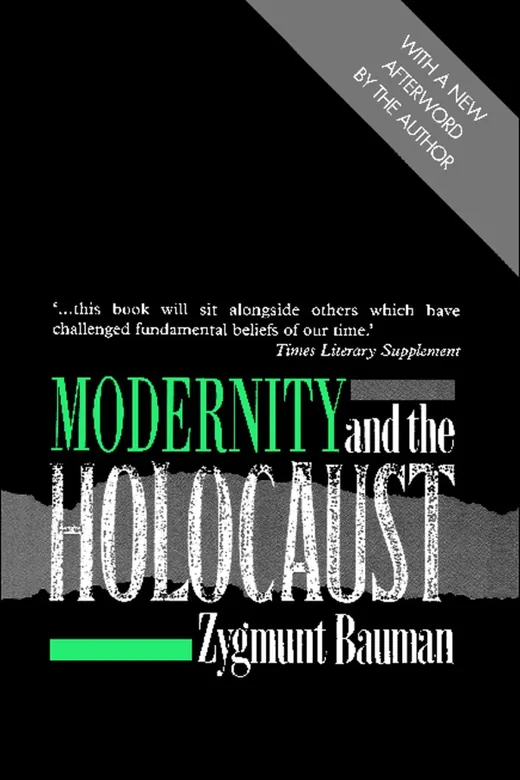
The cover of Modernity and the Holocaust by Zygmunt Bauman [Cornell University Press, 2001] (Paperback) [Paperback]

Modernity and the Holocaust by Zygmunt Bauman [Cornell University Press, 2001] (Paperback) [Paperback]

What does the Holocaust reveal about modern society and about how it organizes people?

At a glance

Author
Zygmunt Bauman

Why read it

  • You will question the comforting picture of mass murder as the work of mad and wicked people alone
  • You will see how large organizations can make it easy not to see the moral weight of what you do
  • You will be able to ask how far social distance makes cruelty easier

Who it is for

  • Someone who has studied the Holocaust and still asks how it happened
  • A manager or civil servant who follows rules inside a large organization
  • A student of sociology or ethics looking for hard questions

Contents

  1. Preface
  2. The Holocaust as the test of modernity
  3. The meaning of the civilizing process
  4. Social production of moral indifference
  5. Social production of moral invisibility
  6. Moral consequences of the civilizing process
  7. Some peculiarities of Jewish estrangement
  8. Jewish incongruity from Christendom to modernity
  9. Astride the barricades
  10. The prismatic group
  11. Modern dimensions of incongruity
  12. The non-national nation
  13. The modernity of racism
  14. From heterophobia to racism
  15. Racism as a form of social engineering
  16. From repellence to extermination
  17. Looking ahead
  18. The problem
  19. Genocide extraordinary
  20. Peculiarity of modern genocide
  21. Dehumanization of bureaucratic objects
  22. The role of bureaucracy in the Holocaust
  23. Bankruptcy of modern safeguards
  24. Conclusions
  25. ‘Sealing off’ the victims
  26. The ‘save what you can’ game
  27. Individual rationality in the service of collective destruction
  28. Rationality of self-preservation
  29. Conclusion
  30. Inhumanity as a function of social distance
  31. Complicity after one’s own act
  32. Technology moralized
  33. Free-floating responsibility
  34. Pluralism of power and power of conscience
  35. The social nature of evil
  36. Society as a factory of morality
  37. The challenge of the Holocaust
  38. Pre-societal sources of morality
  39. Social proximity and moral responsibility
  40. Social suppression of moral responsibility
  41. Social production of distance
  42. Final remarks
  43. 8. Afterthought: Rationality and Shame
  44. Social Manipulation of Morality: The European Amalfi Prize Lecture
  45. The Duty to Remember – But What?: Afterword to the 2000 Edition

More books like this