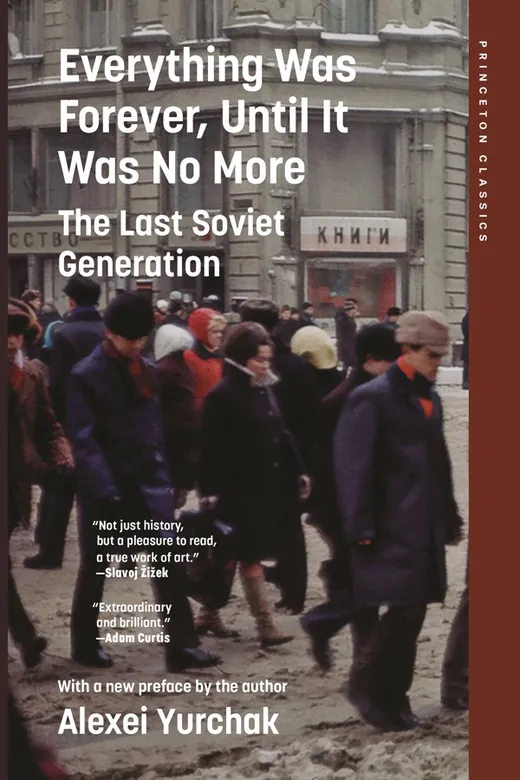
The cover of Everything Was Forever, Until It Was No More

Everything Was Forever, Until It Was No More

How did Soviet people live inside a system where taking part in speeches, meetings and votes mattered more than what the words literally said, and what did that leave behind?

At a glance

Author
Alexei Yurchak

Why read it

  • You will stop reading life under a regime as a simple split between public lies and private truth
  • You will learn to see when taking part in a ritual matters more than what the words mean
  • You will understand how habits learned under one system carry into the next, such as the rush of new private businesses

Who it is for

  • A reader of Russian history who wants more than Cold War stereotypes
  • Someone raised in the late Soviet system or one like it
  • A manager puzzled by meetings and votes that mean little

Contents

  1. More Praise for Everything Was Forever, Until It Was No More
  2. EVERYTHING WAS FOREVER, UNTIL IT WAS NO MORE
  3. Series statement Page
  4. PREFACE TO THE PRINCETON CLASSICS EDITION
  5. Symptomatic Reading
  6. Language and the Material World
  7. Performative Shift, Hypernormalization, and Living Inside/Outside
  8. Hypernormalization Today
  9. Creative Afterlife
  10. EVERYTHING WAS FOREVER, UNTIL IT WAS NO MORE
  11. 1 Late Socialism AN ETERNAL STATE
  12. An Eternal State
  13. Binary Socialism
  14. Everyday Realities
  15. Lefort’s Paradox
  16. Acts and Rituals
  17. Actors in Masks
  18. The Performative
  19. Speech Acts and Ritualized Acts
  20. Constative and Performative Dimensions
  21. Performative Shift
  22. Creative Productions
  23. Materials and Methods
  24. Survey of Chapters
  25. 2 Hegemony of Form STALIN’S UNCANNY PARADIGM SHIFT
  26. Authoritative Discourse
  27. Revolutionary Language
  28. Stalin the External “Master”
  29. Stalin’s Paradigm Shift
  30. The Normalization of Language
  31. Monosemic Language
  32. The Pragmatic Model
  33. The Discourse of Visual Propaganda and Rituals
  34. The Shift of Voice and Temporality
  35. Citational Temporality
  36. Manifest Intertextuality
  37. FIGURE 2.1. The Ideological Conviction of the Soviet Person. Author’s translation.
  38. Complex Modifiers
  39. Complex Nominalizations
  40. Displaced Agency
  41. Rhetorical Circularity
  42. Narrative Circularity
  43. Performative Dimension
  44. 3 Ideology Inside Out ETHICS AND POETICS
  45. Ideological Poetics
  46. Local Komsomol Cadres
  47. A Professional Secretary
  48. An Unprofessional Secretary
  49. Secondary School Komsorgs and Secretaries
  50. “Work with Meaning” by Means of “Pure Pro Forma”
  51. “Little Tricks”
  52. Activists, Dissidents, and Svoi
  53. Performing Svoi
  54. Deterritorialization
  55. The Public of Svoi
  56. “Normal Life”
  57. Parades
  58. Soviet Newspapers
  59. Central Committee Analysts
  60. 4 Living “Vnye” DETERRITORIALIZED MILIEUS

More books like this