Knowingo
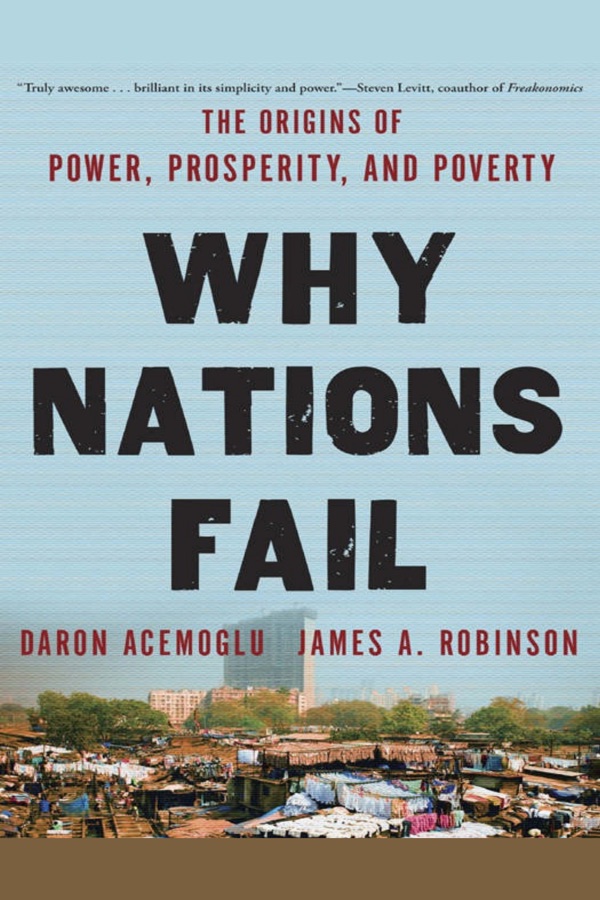
The cover of Why Nations Fail

Why Nations Fail

See why some countries stay poor while neighbors thrive, and learn to judge any reform by whether it actually widens who holds power and can hold rulers accountable.

16 parts, about 22 minutes to read.

Why read it

  • Argues that nations stay poor when a narrow elite controls politics and the economy, not because of climate or culture
  • Helps you judge reforms, aid and elections by one question: do they actually widen who holds power
  • Tests the theory against paired cases across centuries, from a town split by a border to a divided peninsula

Who it is for

  • Readers asking why some countries grow and others stall
  • People working in development aid or policy reform
  • Students of history who want a single testable framework

What the summary covers

  1. Preface2 min
  2. 1. So Close and Yet So Different2 min
  3. 2. Theories That Don’t Work1 min
  4. 3. The Making of Prosperity and Poverty1 min
  5. 4. Small Differences and Critical Junctures: The Weight of History1 min
  6. 5. “I’ve Seen the Future, and It Works”: Growth Under Extractive Institutions1 min
  7. 6. Drifting Apart1 min
  8. 7. The Turning Point1 min
  9. 8. Not on Our Turf: Barriers to Development1 min
  10. 9. Reversing Development1 min
  11. 10. The Diffusion of Prosperity1 min
  12. 11. The Virtuous Circle1 min
  13. 12. The Vicious Circle1 min
  14. 13. Why Nations Fail Today1 min
  15. 14. Breaking the Mold2 min
  16. 15. Understanding Prosperity and Poverty4 min

Recommended by

  • Francis FukuyamaAuthor of The End of History and the Last Man
    This highly accessible book provides welcome insight to specialists and general readers alike.

  • Michael SpenceNobel laureate in economics
    This not only a fascinating and interesting book: it is a really important one
  • Gary S. BeckerNobel laureate in economics
    This intimate connection between political and economic institutions is the heart of [the authors’] major contribution
  • Simon JohnsonProfessor at MIT Sloan
    A brilliant and uplifting book
  • George AkerlofNobel laureate in economics
  • George AkerlofNobel laureate in economics

About the authors

  • Daron AcemogluNobel laureate in economic sciences and MIT Institute Professor
    • Born 3 September 1967 in Istanbul, Turkey
    • BA in economics from the University of York in 1989
    • MSc 1990 and PhD 1992 from the London School of Economics
    • At MIT since 1993; Killian Professor of Economics
    • Named MIT Institute Professor in 2019
    • John Bates Clark Medal in 2005
    • Nobel citation links institutions imposed by European colonisers to prosperity, the argument of Why Nations Fail
  • James A. RobinsonNobel laureate in economics and University of Chicago professor
    • Born 27 February 1960 in Chelmsford, England
    • BSc LSE 1982, MA Warwick 1986, PhD Yale 1993
    • Taught at Harvard 2004 to 2015
    • University Professor at the Harris School, University of Chicago
    • Led the Pearson Institute for the Study and Resolution of Global Conflicts
    • Fieldwork across countries; teaches every summer in Bogotá
    • Nobel citation links colonial era institutions to prosperity, the argument of Why Nations Fail

More books like this