Knowingo
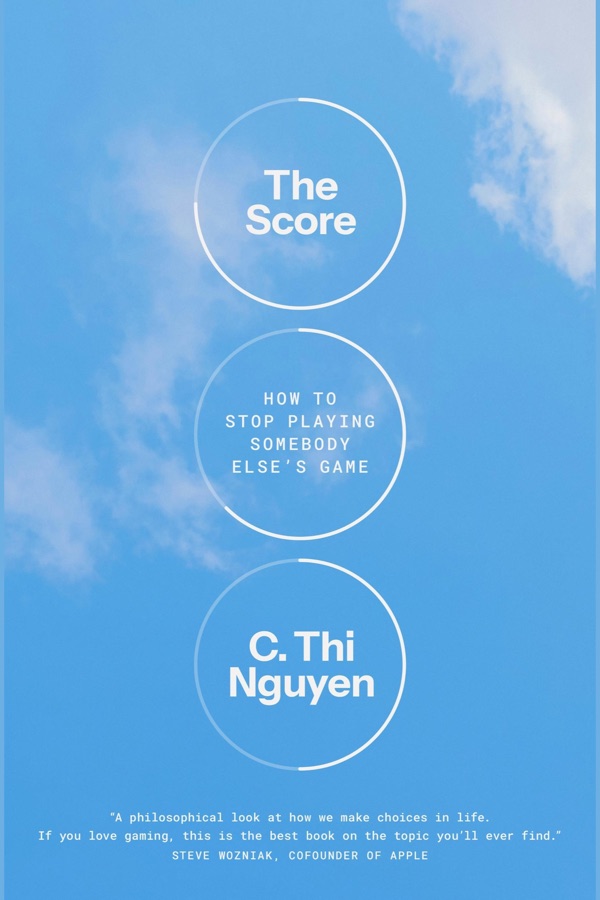
The cover of The Score

The Score

Why do grades, rankings and step counts take over what we care about? Nguyen shows how games teach us to use scores without letting them rule us.

14 parts, about 24 minutes to read.

Why read it

  • Names value capture: how rankings and metrics quietly replace our own rich values with simplified scores built for institutions
  • Helps you notice when a number has taken over what you care about in work, health or play, and how to take it back
  • A philosopher's argument built from games and play, contrasting striving for the fun of it with chasing the score

Who it is for

  • Professionals whose work is judged by rankings or targets
  • Teachers and managers designing grading or performance metrics
  • Fitness tracker users who feel the numbers took over

What the summary covers

  1. When a Score Takes Over3 min
  2. Striving Play2 min
  3. Value Capture2 min
  4. Scores Change the Subject1 min
  5. The Art of Agency1 min
  6. Transparency Is Surveillance2 min
  7. The Limits of Data2 min
  8. Mechanical Rules2 min
  9. Reflective Control1 min
  10. Metrics Standardize Values1 min
  11. Islands and Centers2 min
  12. Living with Metrics1 min
  13. How Metrics Seduce2 min
  14. Infrastructures of Play2 min

Recommended by

  • Steve WozniakCofounder of Apple
    As a long-time fan of games, I was delighted to find a philosophical look at how we make choices in life.

  • Johann HariAuthor of Stolen Focus and Chasing the Scream
    One of the most clever and revealing books I have read in a long time.
  • Jordan EllenbergAuthor of How Not to Be Wrong

About the author

  • C. Thi NguyenProfessor of philosophy at the University of Utah, known for philosophy of games
    • Majored in philosophy at Harvard, then worked as a tech writer in the Boston area
    • Philosophy PhD at UCLA, finished while working as a food writer for the Los Angeles Times
    • First book Games: Agency as Art won the American Philosophical Association's 2021 Book Prize
    • Professor at the University of Utah since 2020, previously at Utah Valley University
    • Writes for the public for The New York Times, The Washington Post and New Statesman

More books like this