Knowingo
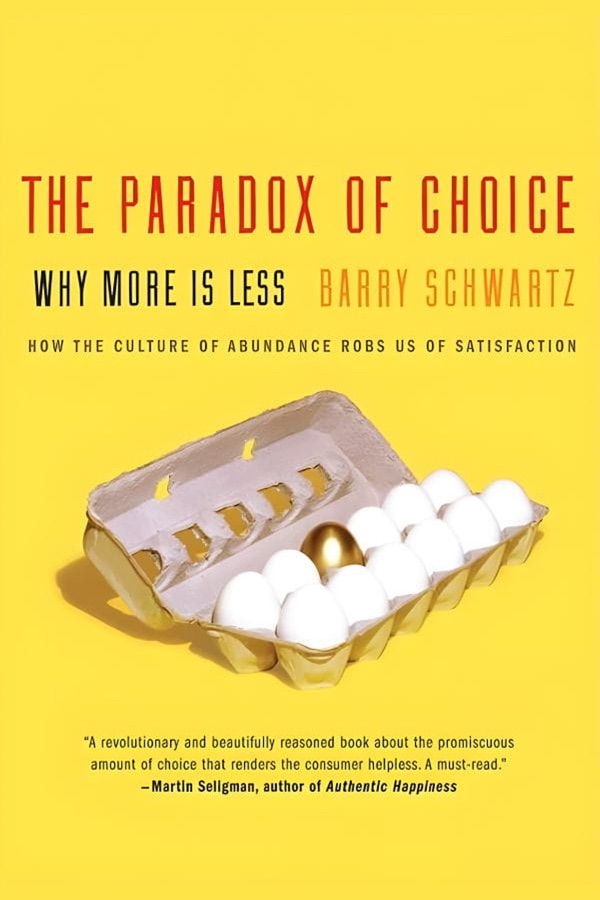
The cover of The Paradox of Choice: Why More Is Less

The Paradox of Choice: Why More Is Less

Explore why expanding options can erode satisfaction and how Barry Schwartz uses satisficing, commitments, and selective limits to make choice serve a fuller life.

5 parts, about 20 minutes to read.

Why read it

  • Understand why a larger menu can cut buying, as when shoppers at a six jam table bought far more often than at twenty four
  • Tell maximizers from satisficers and see why seeking the top option goes with more regret and less happiness
  • Learn practical habits: choose when to choose, set a good enough standard before searching, commit to some decisions, practice gratitude

Who it is for

  • Shoppers who lose hours comparing options for small purchases
  • People who keep wondering about the alternatives they rejected
  • Readers weighing health, retirement or insurance plans with many options

What the summary covers

  1. When More Choices Change the Choice1 min
  2. The Expanding Menu4 min
  3. How We Decide4 min
  4. Why a Good Option Can Feel Disappointing8 min
  5. Choosing What to Choose3 min

Recommended by

  • Martin SeligmanAuthor of Learned Optimism and Authentic Happiness
    The Paradox of Choice is a must read for every thoughtful person.
  • Daniel KahnemanNobel laureate in economics, Princeton University
    It argues persuasively that most of us would often be better off with fewer options, and that many of us try too hard to make the best choices.

  • Derek SiversEntrepreneur, founder of CD Baby, writer

About the author

  • Barry SchwartzEmeritus professor of psychology at Swarthmore College who studies decision making
    • He was born on August 15, 1946, and is an American psychologist.
    • He earned his PhD at the University of Pennsylvania under David Richmond Williams, as a National Science Foundation predoctoral fellow.
    • He is the Dorwin Cartwright Emeritus Professor of Social Theory and Social Action at Swarthmore College and has been a visiting professor at the University of California, Berkeley since 2016.
    • His work sits at the intersection of psychology and economics, and he is a critic of the rational economic man model.
    • He has published a dozen books and over 200 articles, and his TED talks have been viewed more than 12 million times.
    • His 2004 book The Paradox of Choice was named one of the top business books of that year by both Business Week and Forbes, and has been translated into twenty five languages.
    • He later wrote Practical Wisdom with Kenneth Sharpe in 2010 and Why We Work in 2015.

More books like this