Knowingo
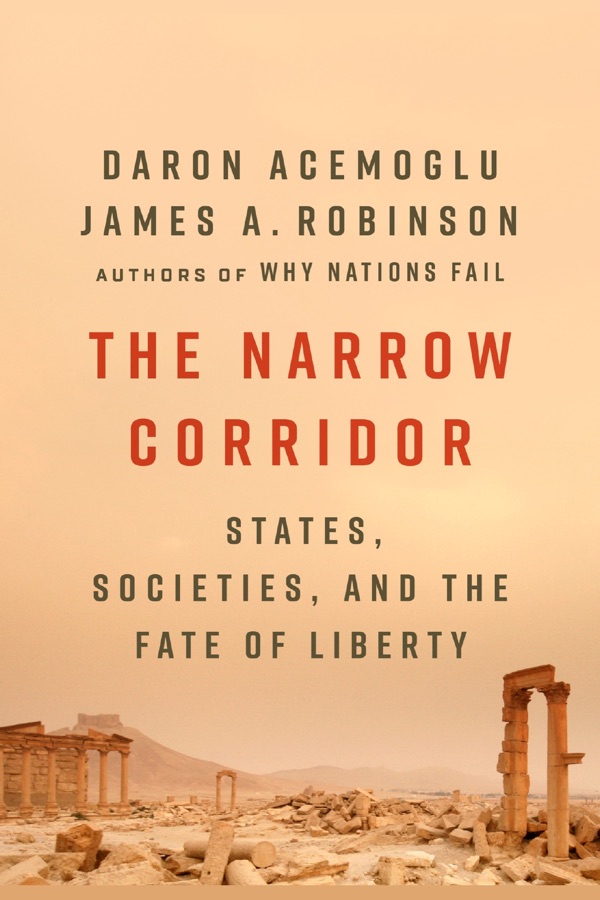
The cover of The Narrow Corridor

The Narrow Corridor

Why do some nations win liberty while others slide into despotism or chaos? Acemoglu and Robinson show freedom needs a strong state and a mobilized society checking each other.

16 parts, about 41 minutes to read.

Why read it

  • Argues that liberty lives in a narrow corridor where a strong state and a mobilized society keep checking each other
  • Gives you a simple map of despotic, absent, paper and shackled states for reading any country's news or history
  • Ranges from ancient Athens and medieval Siena to India, China, Colombia and Ferguson to show that history is not destiny

Who it is for

  • Readers of politics wondering why democracies slide into despotism
  • Students of economic development and comparative history
  • Activists and organizers pushing their governments to change

What the summary covers

  1. Liberty is taken, not granted3 min
  2. Three kinds of Leviathan4 min
  3. The Red Queen4 min
  4. The will to power1 min
  5. Economies outside the corridor2 min
  6. The economy inside the corridor2 min
  7. The European scissors3 min
  8. China's Despotic Leviathan2 min
  9. India's broken Red Queen2 min
  10. The devil in the details3 min
  11. America's paradoxical Leviathan2 min
  12. The Paper Leviathan2 min
  13. Tightening the cage in the Middle East2 min
  14. The Red Queen out of control3 min
  15. Doorways into the corridor3 min
  16. Living with the Leviathan3 min

Recommended by

  • Satya NadellaCEO of Microsoft
    Fantastic.
  • Jared DiamondProfessor of geography at UCLA and Pulitzer Prize winning author of Guns, Germs, and Steel
  • George AkerlofNobel laureate in economics, 2001

About the authors

  • Daron AcemogluNobel laureate in economic sciences and MIT Institute Professor
    • An Institute Professor at MIT and faculty codirector of the Stone Center on Inequality and Shaping the Future of Work.
    • His research spans political economy, development, growth, technological change, inequality, labor economics and economic networks.
    • He was born on 3 September 1967 in Istanbul, Turkey.
    • He received the 2024 prize in economic sciences for research on how institutions form and affect prosperity.
  • James A. RobinsonNobel laureate in economics and University of Chicago professor
    • Born 27 February 1960 in Chelmsford, England
    • BSc LSE 1982, MA Warwick 1986, PhD Yale 1993
    • Taught at Harvard 2004 to 2015
    • University Professor at the Harris School, University of Chicago
    • Led the Pearson Institute for the Study and Resolution of Global Conflicts
    • Fieldwork across countries; teaches every summer in Bogotá
    • Nobel citation links colonial era institutions to prosperity, the argument of Why Nations Fail

More books like this