Knowingo
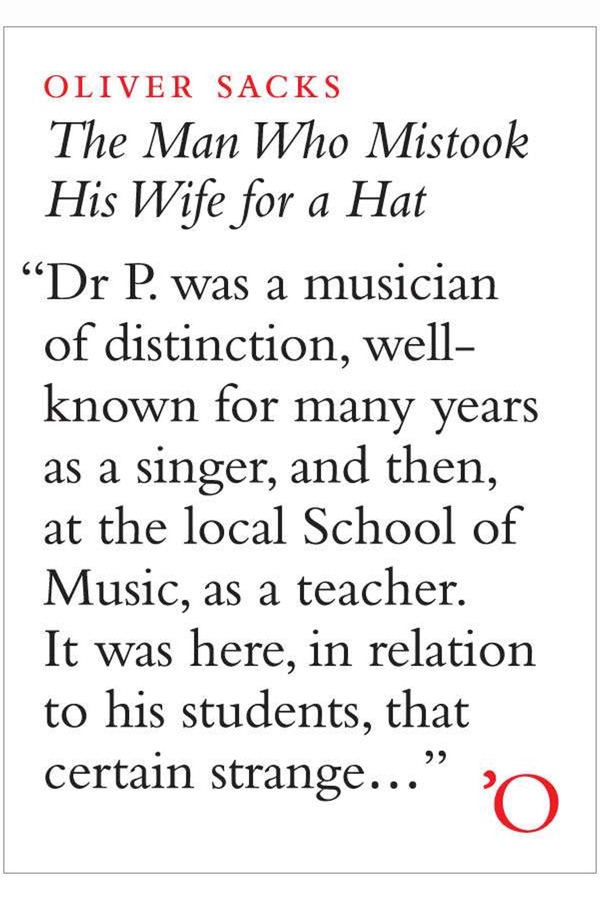
The cover of The Man Who Mistook His Wife for a Hat

The Man Who Mistook His Wife for a Hat

Clinical tales of patients who lost or gained a part of the self, including a man who mistook his wife for a hat, told by their neurologist.

21 parts, about 27 minutes to read.

Why read it

  • Follows a music teacher who mistook his wife's head for a hat and described a glove as a continuous surface, seeing features but no person
  • Shows a sailor whose memory stops in his youth, who forgets the doctor within two minutes yet attends fully in chapel
  • Shows twins who trade primes and give any date's weekday within forty thousand years either way, plus a hospital patient drawing a pocket watch faithfully

Who it is for

  • Readers curious how brain damage alters memory, perception and sense of self
  • Medical students and doctors who want patients' stories beside diagnoses
  • Carers of people with intellectual disability

What the summary covers

  1. Why I tell these cases as tales1 min
  2. Losses1 min
  3. The man who mistook his wife for a hat1 min
  4. Testing Dr P. at home2 min
  5. The Lost Mariner2 min
  6. Jimmie in the chapel1 min
  7. Christina loses the sense of her body2 min
  8. Madeleine finds her hands1 min
  9. The President's speech1 min
  10. Excesses1 min
  11. Ray and Tourette's syndrome1 min
  12. Ray, on and off Haldol1 min
  13. Natasha K. and Cupid's Disease1 min
  14. Mr Thompson, who made up his world1 min
  15. Music in the head2 min
  16. Bhagawhandi's visions of home1 min
  17. The world of the simple: Rebecca1 min
  18. Rebecca in grief, and on stage1 min
  19. Martin A. and Bach1 min
  20. The twins John and Michael2 min
  21. José, who draws2 min

Recommended by

  • Noel PerrinReviewer for the Chicago Sun Times
    Dr. Sacks’s best book….One sees a wise, compassionate and very literate mind at work in these 20 stories, nearly all remarkable, and many the kind that restore one’s faith in humanity.
  • Clarence E. OlsenReviewer for the St. Louis Post Dispatch
    A provocative introduction to the marvels of the human mind….

  • Atul GawandeSurgeon, writer and Harvard professor
    [Sacks] captured both the medical and the human drama of illness . . . He would see patients not as collections of deficits but as unique individuals… He captured their experiences, their hopes and fears, their humour and perseverance. It is heroic stuff, and he was well aware of its mythic resonances.
About the author

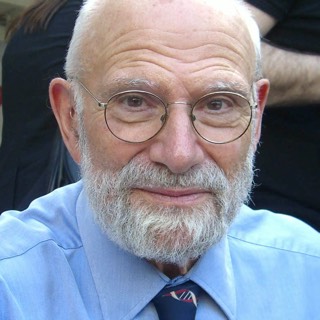
  • Oliver SacksBritish neurologist and writer
    • Born in London in 1933 and died in 2015, a British neurologist, naturalist, historian of science and writer.
    • Youngest of four children of a doctor, Samuel Sacks, and Muriel Elsie Landau, one of the first female surgeons in England.
    • Took his medical degrees at Oxford in 1958, having entered The Queen's College, Oxford, in 1951.
    • Moved to North America in 1960 and in 1961 reached the United States, where he interned in San Francisco and trained in neurology at UCLA.
    • His treatment of survivors of the 1920s sleeping sickness epidemic at Beth Abraham Hospital in the Bronx became his 1973 book Awakenings, later made into a film.
    • Taught clinical neurology at the Albert Einstein College of Medicine from 1966 to 2007, held an appointment at NYU from 1992 to 2007 and joined Columbia University Medical Center in 2007.
    • Believed his lifelong shyness came from his own prosopagnosia (face blindness), a condition he studied in patients including the title case of this book.
    • Received the Lewis Thomas Prize for Writing about Science from Rockefeller University in 2001.

More books like this