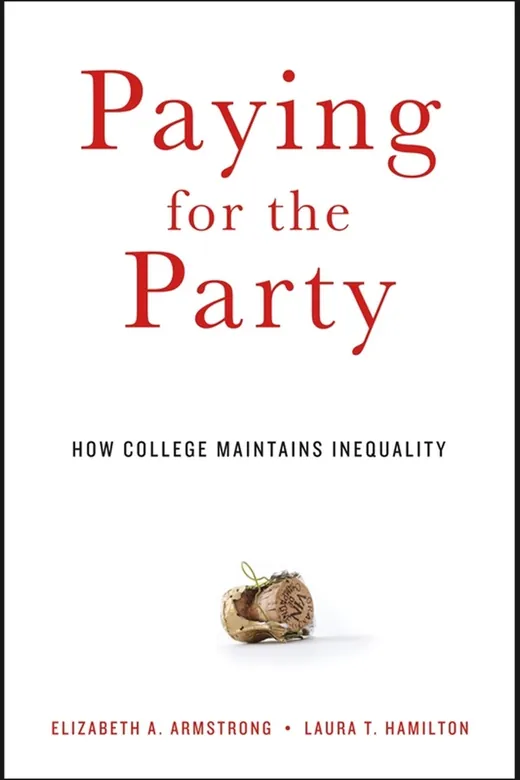
The cover of Paying for the Party: How College Maintains Inequality

Paying for the Party: How College Maintains Inequality

How do campus social life and family money shape which young women get ahead at a large public university?

At a glance

Author
Elizabeth A. Armstrong, Laura T. Hamilton

Why read it

  • You will see how campus life can reward family money with a smoother ride through college
  • You will learn about three different routes through college and which students are steered toward each
  • You will understand why caring parents with limited money and know how cannot always rescue a struggling student

Who it is for

  • A parent choosing a university and wondering what to expect there
  • A first generation student asking why campus feels so unequal
  • An admissions or campus staff member who shapes student life

Contents

  1. Preface
  2. Introduction
  3. Inside the Black Box of Higher Education
  4. The Study
  5. Overview of the Argument
  6. Class Projects
  7. Class Reproduction through Social Closure
  8. Class Mobility
  9. Class Reproduction through Achievement
  10. College Pathways
  11. The Party Pathway
  12. The Mobility Pathway
  13. The Professional Pathway
  14. Organizational Imperatives
  15. The Flow of Students through the University
  16. Structure of the Book
  17. Who Attends Midwest University?
  18. Class Background of Study Participants
  19. Class Culture and Class-Based Resources
  20. Social Class, Gender Style, and Orientations to College
  21. Primed to Party
  22. Cultivated for Success
  23. Motivated for Mobility
  24. MU by Default
  25. Greek Life
  26. University Resources and Support for Greek Life
  27. Greek Bureaucracy and the Social Calendar
  28. “Greedy” Greek Organizations
  29. Residence Life
  30. Sorting into Residential Communities
  31. Residential Reputations and Neighborhood Choice
  32. The Puzzle of Dorm Preferences
  33. Easy Majors
  34. Getting the Bid: Peer Hierarchies and Investment in Greek Life
  35. Greek Exclusivity
  36. Selection on the Basis of “Personality”
  37. Social Class, Race, Religion, and “Cuteness”
  38. Pleasure and Peril in the Party Scene
  39. Erotic Status and the Role of “Hooking Up”
  40. An Uneven Playing Field
  41. The Costs
  42. Isolates
  43. Social Dynamics of the Floor
  44. Dissociation and Status
  45. Refusing Acknowledgment
  46. Communicating Popularity
  47. The Vampire Effect
  48. The Consequences of Social Isolation
  49. Limited Social Networks Later in College
  50. Lack of Goals and Interests
  51. Academic Disengagement
  52. Mental Health Issues
  53. Limited Access to Information
  54. Leaving the University
  55. Exceptions to the Rule
  56. Social and Erotic Status
  57. The Socialite Experience: Comfort and Ease in the Social Scene
  58. The Wannabe Experience: Not Measuring Up
  59. Academic Success
  60. The Socialite Experience: Making a Low-Effort Approach Work

More books like this