Knowingo
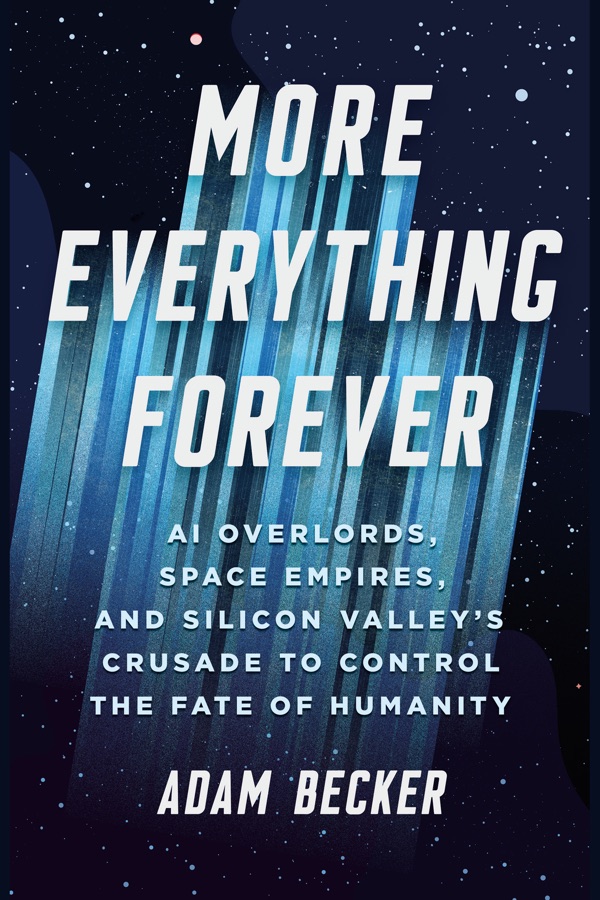
The cover of More Everything Forever

More Everything Forever

See how futuristic promises turn speculative science into political authority, conceal present harms, and narrow the futures society is allowed to imagine.

7 parts, about 26 minutes to read.

Why read it

  • Argues that visions of superintelligence, endless growth and space colonies mainly empower those who profit from promising them
  • Gives tools for testing grand forecasts: demand a mechanism, look for the S curve, distrust tiny odds times huge numbers
  • Checks the promises against physical limits, from chip scaling to Mars soil, while taking the longings behind them seriously

Who it is for

  • Readers skeptical of both AI hype and AI doom
  • Tech workers questioning their industry's grand mission
  • Donors weighing effective altruism and longtermist causes

What the summary covers

  1. Who Gets to Name the Future?2 min
  2. From Charity to Astronomical Arithmetic4 min
  3. The Exponential Promise Meets the S Curve4 min
  4. The Paperclip and the People Already in the System4 min
  5. Ethics at Astronomical Scale4 min
  6. No Planet B4 min
  7. An Open Future4 min

Recommended by

  • Kim Stanley RobinsonScience fiction author of The Ministry for the Future
    This is an important book as well as a good one.
  • Cory DoctorowScience fiction author and digital rights activist
    Our world has fallen into the clutches of billionaires who mistake dystopian science fiction stories for suggestions, rather than warnings.
  • Melanie MitchellComputer scientist and author of Artificial Intelligence
    A fascinating exposé of the extreme techno-solutionism promoted by the most powerful and influential technocrats of our era.
About the author

  • Adam BeckerAstrophysicist and author
    • Born 1984 in New Jersey
    • BA in philosophy and physics, Cornell University, 2006
    • PhD in physics, University of Michigan, 2012
    • Science journalist who has written for the New York Times, BBC, NPR, Scientific American, New Scientist and Quanta
    • First book What Is Real? was a New York Times Book Review Editor's Choice and long listed for the PEN Literary Science Writing Award
    • Science journalism fellow at the Santa Fe Institute and science communicator in residence at the Simons Institute for the Theory of Computing
    • Visiting scholar at UC Berkeley in 2018

More books like this